

Medically reviewed by Dr. Rao Khurram Ayoub, RPh, PhD (Pharmaceutics)
Written by Dr. Muhammad Imran, M.Phil, PharmD, BSc
Updated on
What Is BMI (Body Mass Index)?
Body Mass Index (BMI) is a widely used screening tool that helps estimate whether your weight falls within a healthy range based on your height. It is calculated using a simple formula:
BMI = weight (kg) ÷ height² (m²)
Why BMI Matters in Clinical Practice
From a pharmacist’s perspective, BMI plays an important role in:
- Identifying underweight, overweight, and obesity
- Assessing cardiovascular risk
- Guiding lifestyle interventions
- Supporting chronic disease management
BMI Categories (WHO Classification)
| BMI Range | Category |
|---|---|
| < 18.5 | Underweight |
| 18.5 – 24.9 | Normal weight |
| 25 – 29.9 | Overweight |
| ≥ 30 | Obese |
Limitations of BMI
While BMI is useful, it has several clinical limitations:
- Does not differentiate between fat and muscle mass
- May misclassify athletes or muscular individuals
- Does not reflect fat distribution
- Less accurate in elderly populations
This is where Body Surface Area (BSA) becomes clinically important.
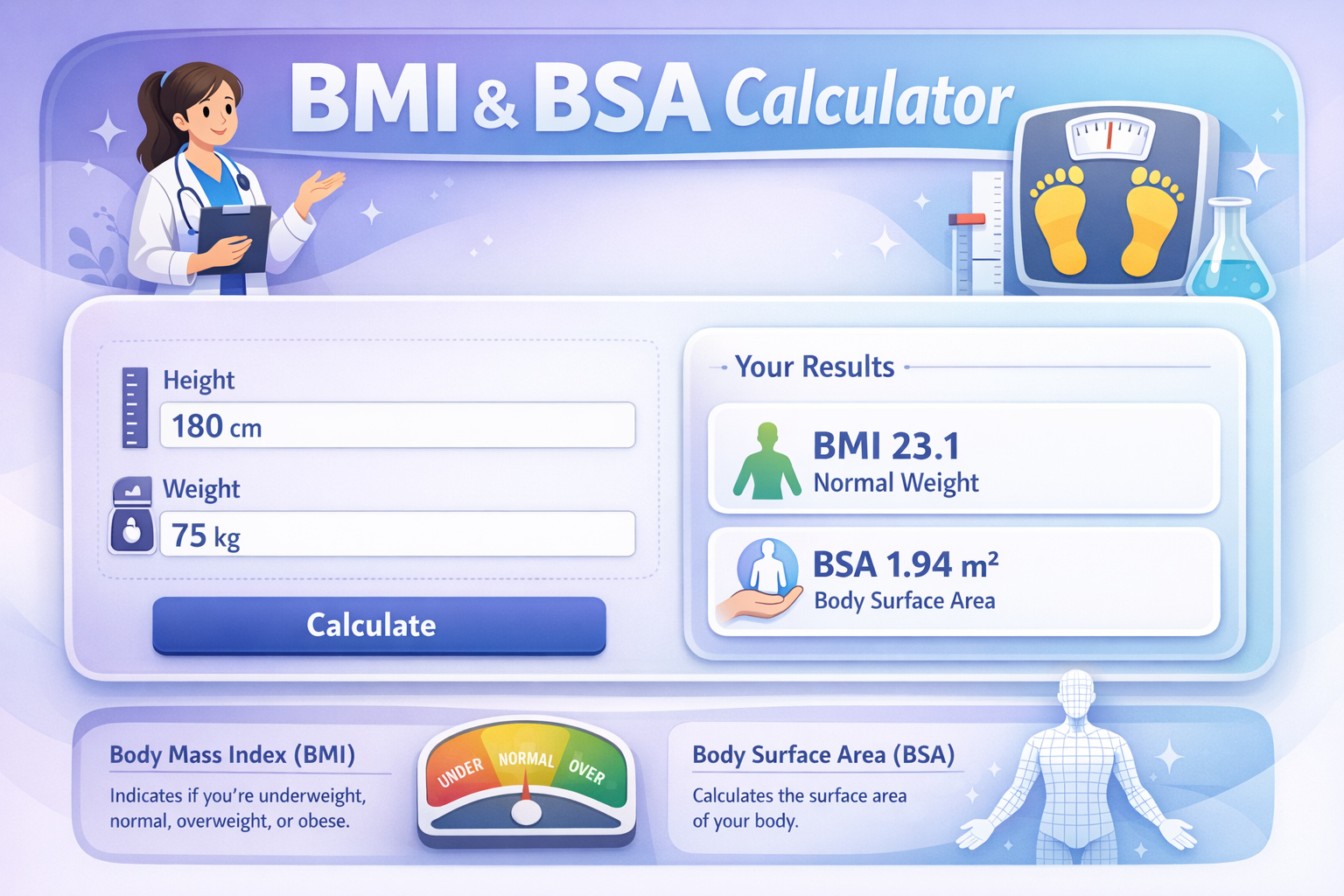
BMI & Body Surface Area Calculator
What Is Body Surface Area (BSA)?
Body Surface Area (BSA) represents the total external surface area of the human body and is measured in square meters (m²).
Unlike BMI, BSA is extensively used in medical dosing and clinical calculations.
How BSA Is Calculated (Mosteller Formula)
The most commonly used formula in clinical practice is:
BSA (m²) = √[(height (cm) × weight (kg)) ÷ 3600]
Why Mosteller Formula Is Preferred
According to a large comparative study:
- The Mosteller formula shows very high correlation (≥0.97) with other complex BSA formulas across different BMI categories
- Simple and accurate
- Widely used in hospitals and oncology
- Recommended for drug dosing calculations
In paediatric and hospital settings:
- Mosteller equation is often considered a “gold standard” for BSA calculation due to simplicity and reliability
Clinical Importance of BSA in Medicine
BSA is far more than just a number—it is essential for precision medicine.
1. Drug Dosing (Especially Chemotherapy)
Many medications are dosed based on mg per m² rather than body weight.
Example:
- Chemotherapy drugs (e.g., cyclophosphamide)
- Immunosuppressants
- Some antibiotics
This ensures:
- Accurate dosing
- Reduced toxicity
- Improved therapeutic outcomes
2. Renal Function Assessment
BSA is used to normalise:
- Glomerular filtration rate (GFR)
- Creatinine clearance
This allows clinicians to compare kidney function across individuals of different sizes.
3. Cardiac Index Calculation
In cardiology, BSA is used to calculate:
- Cardiac output relative to body size
- Cardiac index = cardiac output ÷ BSA
4. Burn Management
In burn patients, BSA helps estimate:
- Total body surface area affected
- Fluid resuscitation need
BMI vs BSA: What’s the Difference?
| Feature | BMI | BSA |
|---|---|---|
| Purpose | Weight classification | Medical dosing |
| Unit | kg/m² | m² |
| Use | General health | Clinical calculations |
| Accuracy | Limited | More precise for dosing |
| Focus | Body fat estimation | Body size surface |
Key Insight
- BMI = population-level screening tool
- BSA = individualised clinical tool
Both should be used together for better assessment.
How to Interpret Your BMI and BSA Results
BMI Interpretation
- Low BMI (<18.5)
May indicate malnutrition, chronic illness, or underweight status - Normal BMI (18.5–24.9)
Associated with lower risk of chronic disease - High BMI (>25)
Linked to:- Hypertension
- Type 2 diabetes
- Cardiovascular disease
BSA Interpretation
Unlike BMI, BSA does not have strict “normal ranges,” but typical adult values are:
- Average adult: 1.6 – 2.0 m²
- Smaller individuals: <1.6 m²
- Larger individuals: >2.0 m²
BSA is interpreted in clinical context, not as a standalone health marker.
Real Clinical Example (Pharmacist Perspective)
Case Scenario
A patient requires a chemotherapy drug dosed at:
50 mg/m²
- Weight: 70 kg
- Height: 170 cm
Step 1: Calculate BSA
BSA = √[(170 × 70) ÷ 3600] ≈ 1.8 m²
Step 2: Calculate Dose
Dose = 50 × 1.8 = 90 mg
This highlights why BSA is critical in dosing accuracy.
Why Combining BMI and BSA Gives Better Insights
Using BMI alone may overlook important clinical factors.
Combined Benefits
- BMI identifies risk level
- BSA guides treatment decisions
Example
Two patients with same BMI may have:
- Different body composition
- Different drug requirements
Limitations of BMI & BSA
BMI Limitations
A 2024 review in Current Obesity Reports explains that BMI:
- Does not reflect fat distribution
- Misleading in athletes
- Ignores muscle mass
BSA Limitations
- Does not measure fat or health risk
- Not useful for weight classification
- Formula variations may cause slight differences
Other BSA Formulas (Advanced Insight)
Although Mosteller is widely used, other formulas exist:
Du Bois Formula
BSA = 0.007184 × weight^0.425 × height^0.725
Haycock Formula
More accurate in children
However, Mosteller remains the standard in clinical practice.
BMI & BSA in Special Populations
1. Children
- BMI uses percentiles
- BSA used in paediatric dosing
2. Elderly
- BMI may underestimate fat
- BSA remains useful for dosing
3. Athletes
- BMI often misleading
- BSA more reliable for medical calculations
How to Use This Calculator Effectively
To get accurate results:
- Enter weight in kilograms
- Enter height in centimetres
- Click calculate
- Review:
- BMI category
- BSA value
- Using incorrect units (lbs instead of kg)
- Relying only on BMI for health decisions
- Ignoring clinical context of BSA
- Not consulting healthcare professionals for dosing
FAQs on BMI & BSA Calculators
Is BMI always accurate?
No, it doesn’t account for muscle mass or ethnic differences.
Which BSA formula is best?
Mosteller is simplest and widely accepted, but Du Bois is considered gold standard.
Can BMI and BSA predict health risks?
BMI helps identify obesity risks; BSA guides drug dosing. Neither is diagnostic alone.
How do I convert units for the calculator?
1 inch = 2.54 cm, 1 pound = 0.45 kg.
What is a healthy BMI?
A BMI between 18.5 and 24.9 is generally considered healthy for most adults.