

Medically reviewed by Dr. Rao Khurram Ayoub, RPh, PhD (Pharmaceutics)
Written by Dr. Muhammad Imran, M.Phil, PharmD, BSc
Updated on
Table of Contents
What is Gouty Arthritis?
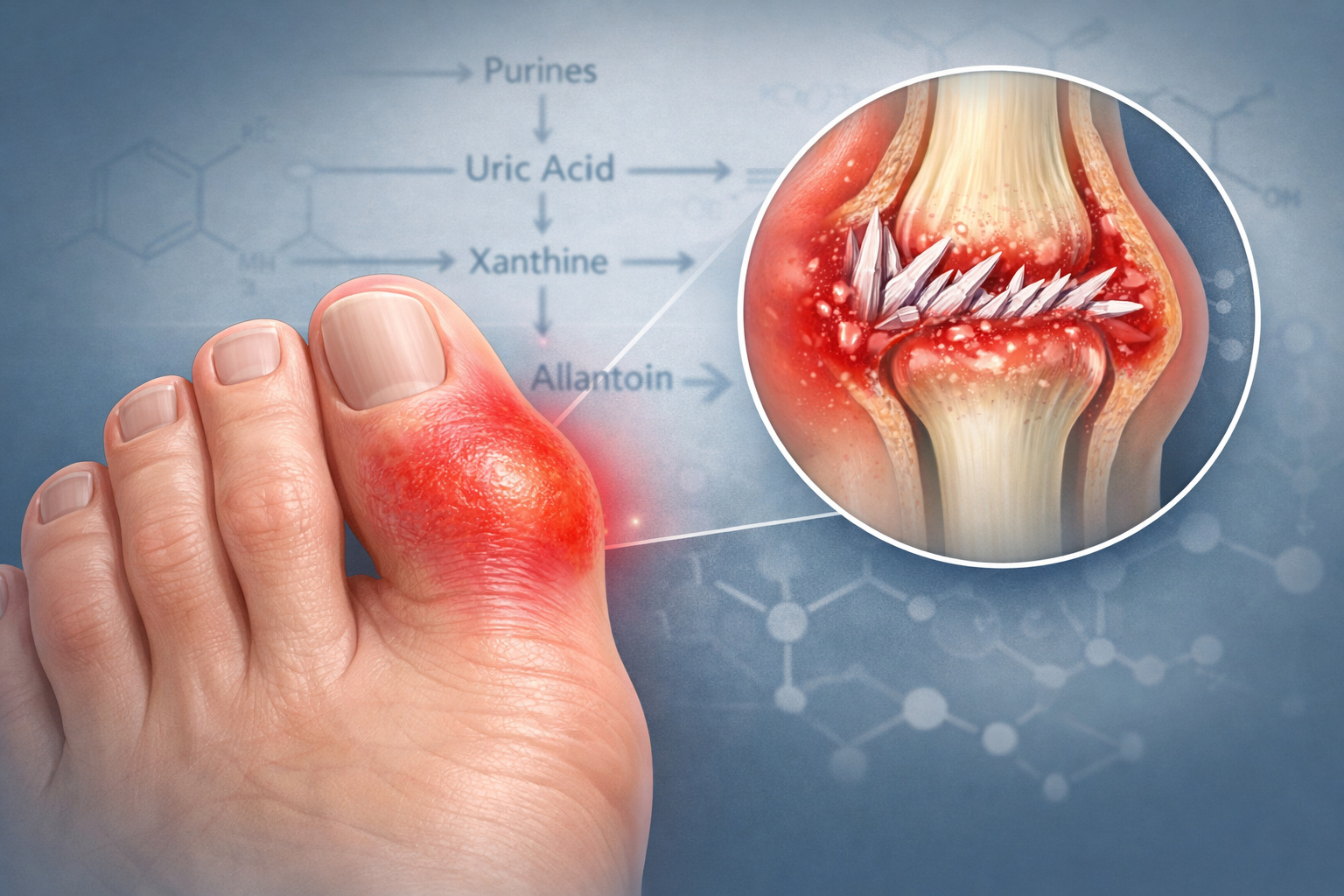
- Gouty arthritis is an inflammatory joint disease caused by monosodium urate crystal deposition due to high uric acid levels. It presents with sudden pain, redness, and swelling, often in the big toe.
- A study by Kłossowska et al., 2025 stated that recent epidemiological data show a continuous global increase in gout prevalence, reaching 1–6% of adults, with strong links to metabolic comorbidities.
Differentiating Gout vs Gouty Arthritis
Definition
Gout: A systemic metabolic disorder due to hyperuricemia (high uric acid).
Gouty Arthritis: A type of inflammatory arthritis caused by urate crystals in joints.
Cause
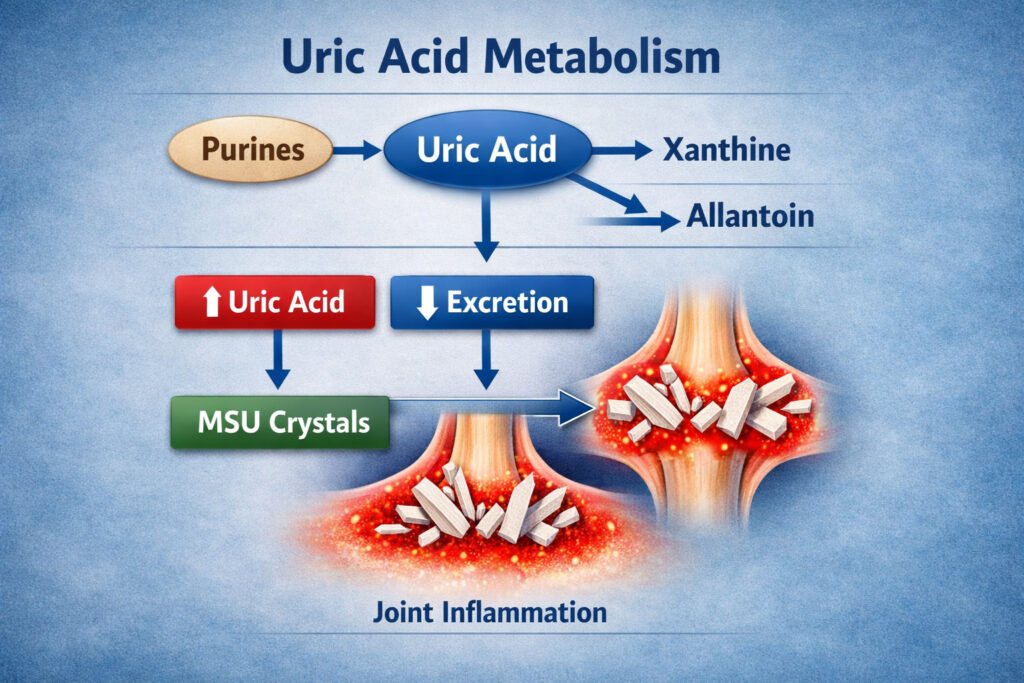
Gout: Overproduction or under‑excretion of uric acid.
Gouty Arthritis: Deposition of monosodium urate crystals in synovial fluid.
Clinical Presentation
Gout: May be asymptomatic for years; uric acid levels elevated.
Gouty Arthritis: Sudden, severe joint pain, swelling, redness often in the big toe (podagra).
Duration
Gout: Chronic metabolic condition.
Gouty Arthritis: Acute flares lasting days to weeks; can become recurrent.
Systemic Impact
Gout: Associated with kidney stones, metabolic syndrome, cardiovascular risk.
Gouty Arthritis: Primarily affects joints; can lead to chronic joint damage if untreated.
Diagnosis
Gout: Blood tests showing high serum uric acid.
Gouty Arthritis: Joint aspiration showing urate crystals; clinical flare pattern.
Treatment Focus
Gout: Lowering uric acid (allopurinol, febuxostat, lifestyle).
Gouty Arthritis: Managing acute inflammation (NSAIDs, colchicine, corticosteroids).
Causes of Gout : Understanding Hyperuricemia
- Excess uric acid results from overproduction or under‑excretion, influenced by purine‑rich diets, genetic variants, and certain medications (e.g., diuretics).
- A study by Chen et al., 2025 stated that hyperuricemia triggers crystal deposition and inflammation via NLRP3 inflammasome activation.
Risk Factors :Who Is Most at Risk?
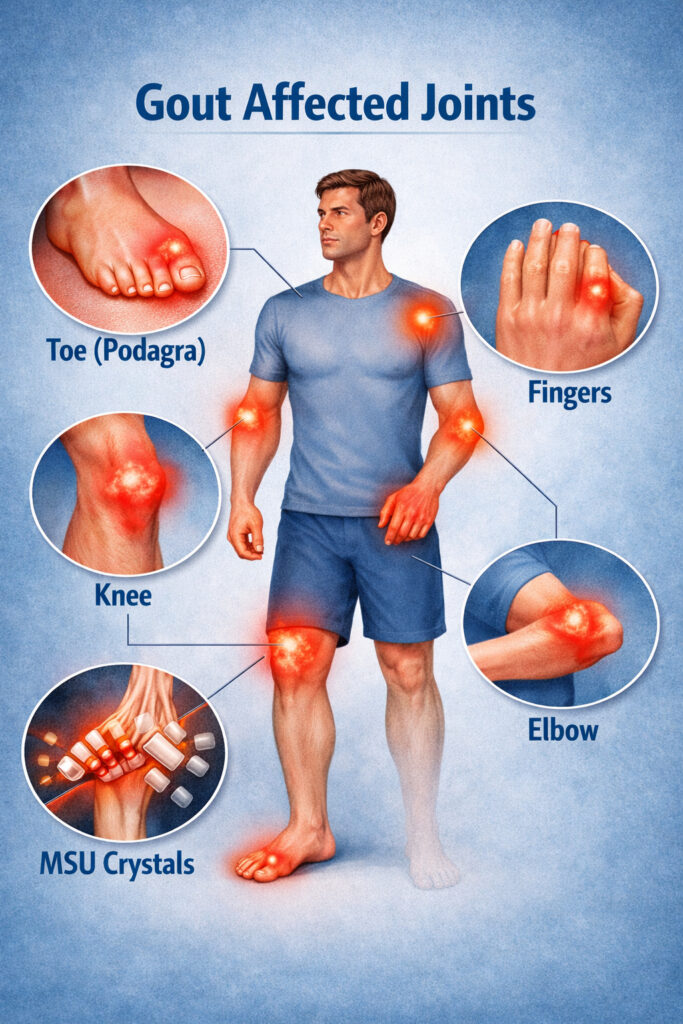
- Age, male gender, obesity, hypertension, and family history increase gout risk. Post‑menopausal women also show rising incidence due to hormonal changes.
- Lifestyle factors such as high meat intake and alcohol consumption further elevate risk.
The Genetic Connection:PPARGC1B and CARD8/IL1B Variants
Recent genomic studies highlight PPARGC1B and CARD8/IL1B polymorphisms as contributors to gout susceptibility. Epigenetic regulation of inflammatory cytokines (IL‑1β, TNF‑α) modulates disease severity.
A study by Zilong Chen et al., 2025 stated that cytokine dysregulation and autophagy defects underpin gout’s autoimmune features.
Diet Management : Foods to Avoid and Include
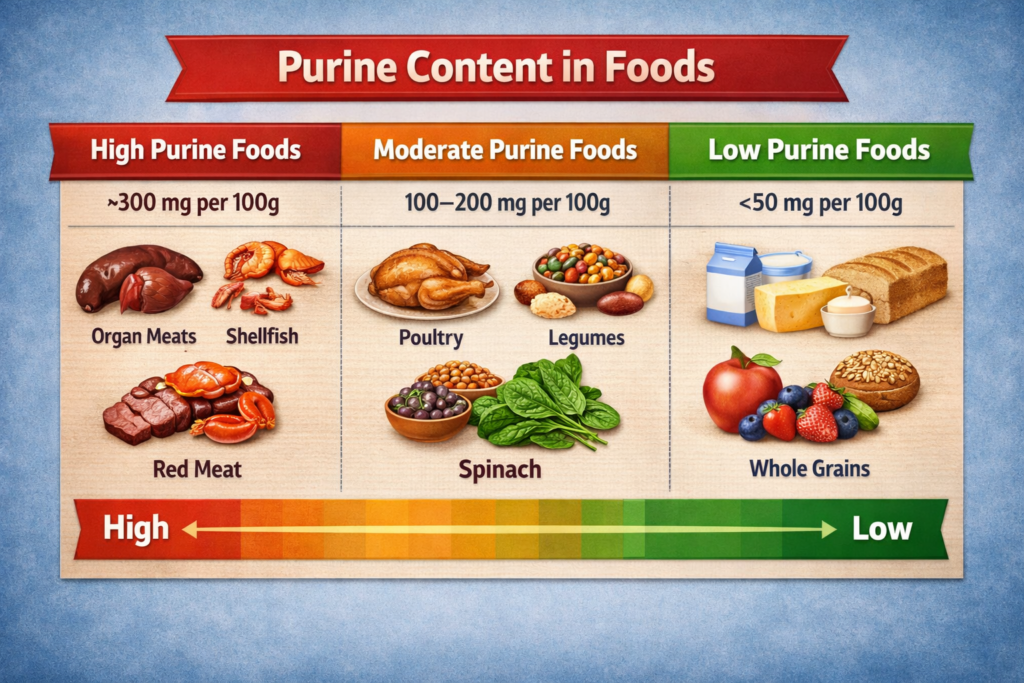
- Avoid red meat, shellfish, sugary drinks, and alcohol; include low‑fat dairy, cherries, and vegetables.
- A study by Kłossowska et al., 2025 stated that a balanced gout diet lowers uric acid and prevents flares. Sample menu: oatmeal breakfast, grilled chicken salad lunch, lentil soup dinner.
Hydration & Lifestyle :Water and Weight Management
- Drink 2–3 litres of water daily, maintain healthy weight, and exercise regularly.
- Hydration aids uric acid excretion, while weight control reduces flare frequency.
- Archiv EuroMedica 2025 states that metabolic control reduces recurrence.
Medical Treatment: NSAIDs, Colchicine, and Allopurinol
- First‑line therapy includes NSAIDs, colchicine, and corticosteroids for acute attacks. Long‑term control uses allopurinol or febuxostat to lower uric acid.
- Zilong Chen et al., 2025 states that Emerging biologics reduce refractory inflammation and target IL‑1β and TNF‑α pathways for resistant cases.
Preventing Flares:Reducing Recurrence
- Maintain serum urate below 6 mg/dL, adhere to medication, and monitor diet. Regular follow‑ups and urate‑tracking tools help prevent flares.
- Physiol Res 2025 states that adherence improves long‑term outcomes.
Gout vs Other Arthritis : Differentiating OA, RA, and Pseudogout
- Gout causes acute monoarticular pain, while RA involves symmetrical polyarthritis.
- Pseudogout features calcium pyrophosphate crystals instead of urate.
- Frontier in Immunology 2025 states that crystal composition defines pathology:
- Gout → monosodium urate crystals.
- Pseudogout → calcium pyrophosphate dihydrate crystals.
Interactive Elements : Digital Tools for Gout Assessment
- Integrate gout symptom tracker, purine calculator, and serum urate goal monitor. These tools enhance patient engagement and adherence.
- Archiv EuroMedica 2025 tells that digital monitoring improves outcomes.
FAQs
What causes gout?
High uric acid from purine metabolism.
Can gout be cured?
Controlled, not cured lifelong management needed.
Is allopurinol safe long‑term?
Yes, with regular renal monitoring.
Does hydration help?
Absolutely : it promotes uric acid clearance.
Refrences
Zeng, S. , He, Q., Wang, R., Chen, B., Zhou, D., Zhou, N., Liao, Y., Zhao, S., Xie, Z., Huang, Z., Li, Z. & Xie, J. (2026). Gouty arthritis model: delving into disease pathways and uncovering possible therapeutic targets. Frontiers in Endocrinology, 17:1752411. DOI: 10.3389/fendo.2026.1752411
Onuora, S. (2026). Novel approach mitigates immunogenicity of uricase treatment in gout. Nature Reviews Rheumatology, 22(2). DOI: 10.1038/s41584-026-00987
Karacabeyli, D. & Lacaille, D. (2025). Glucagon-like peptide-1 receptor agonists in arthritis: current insights and future directions. Nature Reviews Rheumatology, 21(10). DOI: 10.1038/s41584-025-00876
Ea, H.K. & Richette, P. (2025). Factors beyond urate levels for managing gout flares. Nature Reviews Rheumatology, 21(4). DOI: 10.1038/s41584-025-00812
Gérard, B. , Leask, M. & Pascart, T. (2025). Hyperuricaemia and gout in the Pacific: genetic, clinical and cultural aspects. Nature Reviews Rheumatology, 21(3). DOI: 10.1038/s41584-025-00791
Webster, H. (2024). Macrophage-coated nanocarriers for gouty arthritis. Nature Reviews Rheumatology, 20(8). DOI: 10.1038/s41584-024-00712
Leask, M.P. Crișan, T.O. & Merriman, T.R. (2024). The pathogenesis of gout: molecular insights from genetic, epigenomic and transcriptomic studies. Nature Reviews Rheumatology, 20(7). DOI: 10.1038/s41584-024-00701
Gonzalez, R.P. & Guma, M. (2024). Year in Review: Advances in Research in Gout Pathophysiology in 2024. Gout Urate Crystal Deposition Disease, 3(3), 15. DOI: 10.3390/gucdd3030015.
- Kłossowska, M., Ordon, K., Badziąg, M., Szulc, P., Kądziołka, O., Remfeld, M., Herba, M., Boczek, S. & Walkowska, A. (2025) Understanding gout: A review of pathophysiology, diagnosis and management. Archiv EuroMedica, 15(5). DOI: 10.35630/2025/15/Iss.5.505
- Chen, S., Li, Z., Deng, X. & Gao, L. (2025). Advances in understanding the mechanisms of treatment for gouty arthritis: A comprehensive review. Physiological Research, 74, 693–710. DOI: 10.33549/physiolres.935631