

Medically reviewed by Dr. Arham Shabbir, PhD (Pharmacology), M.Phil (Pharmacology), B.Pharm (RPh)
Written by Dr. Muhammad Imran, M.Phil, PharmD, BSc
Updated on
ADHD symptom tracker
Home
Work / School
Social
Other (errands, public)
Purpose of This Checklist
This checklist is designed as a screening and tracking tool to help individuals, parents, and clinicians observe and document ADHD-related behaviors across different settings. It is not a diagnostic instrument but rather a structured way to gather information that can support clinical decision-making.
Clinical Foundation: DSM-5 Criteria
This checklist is grounded in the Diagnostic and Statistical Manual of Mental Disorders, 5th Edition (DSM-5) criteria for Attention-Deficit/Hyperactivity Disorder .
The DSM-5 defines three presentations of ADHD :
| Presentation | Criteria |
|---|---|
| Predominantly Inattentive | 6+ symptoms of inattention (5+ for adults 17+), fewer than 6 hyperactive-impulsive symptoms |
| Predominantly Hyperactive-Impulsive | 6+ symptoms of hyperactivity-impulsivity (5+ for adults 17+), fewer than 6 inattention symptoms |
| Combined Presentation | 6+ symptoms in both dimensions |
Key Diagnostic Requirements
The DSM-5 specifies several essential criteria that inform this checklist’s design :
1. Symptoms Present in Two or More Settings
“Several inattentive or hyperactive-impulsive symptoms are present in two or more settings (e.g., at home, school, or work; with friends or relatives; in other activities).”
This is why the checklist includes multiple settings—home, work/school, social, and other contexts. Cross-setting symptom presentation is a cornerstone of ADHD diagnosis.
2. Symptom Persistence and Impact
Symptoms must have persisted for at least 6 months to a degree inconsistent with developmental level and must negatively impact social, academic, or occupational functioning .
3. Age of Onset
Several symptoms must have been present prior to age 12 years
The Clinical Value of Cross-Setting Assessment
Research has consistently demonstrated that ADHD symptoms vary meaningfully across contexts. A 2015 editorial in the European Child & Adolescent Psychiatry journal emphasized :
“ADHD is not at all context insensitive. Viewing ADHD as a strongly genetically determined disorder may have falsely generated the belief that the disorder must be context independent and rater differences are best viewed as measurement error. Rather, it may be that different scores by different raters are very informative because of differences between the contexts.”
The editorial further notes that children displaying a higher number of symptoms across settings are at increased risk for a more chronic course of the disorder .
Comparison with Established Rating Scales
This checklist shares design elements with validated clinical instruments:
1. Adult ADHD Self-Report Scale (ASRS-v1.1)
Developed in conjunction with the World Health Organization (WHO), the ASRS consists of 18 items based on DSM-IV-TR criteria for ADHD. Six of these items were found most predictive and form the ASRS Screener . The scale addresses symptoms across work, home, and social settings .
2. ADHD Rating Scale–5
This widely used scale has separate Home and School versions, each with two subscales—Inattention (9 items) and Hyperactivity–Impulsivity (9 items)—directly corresponding to DSM-5 criteria. Reliability studies show alpha coefficients ranging from .89 to .96, and test-retest reliability from .80 to .93 .
3. Home and School Situations Questionnaires (HSQ-R and SSQ-R)
These instruments evaluate children’s attention difficulties across specific situations, assessing both the number of problem settings and severity ratings. Normative data are available by age and gender .
Understanding the Symptoms
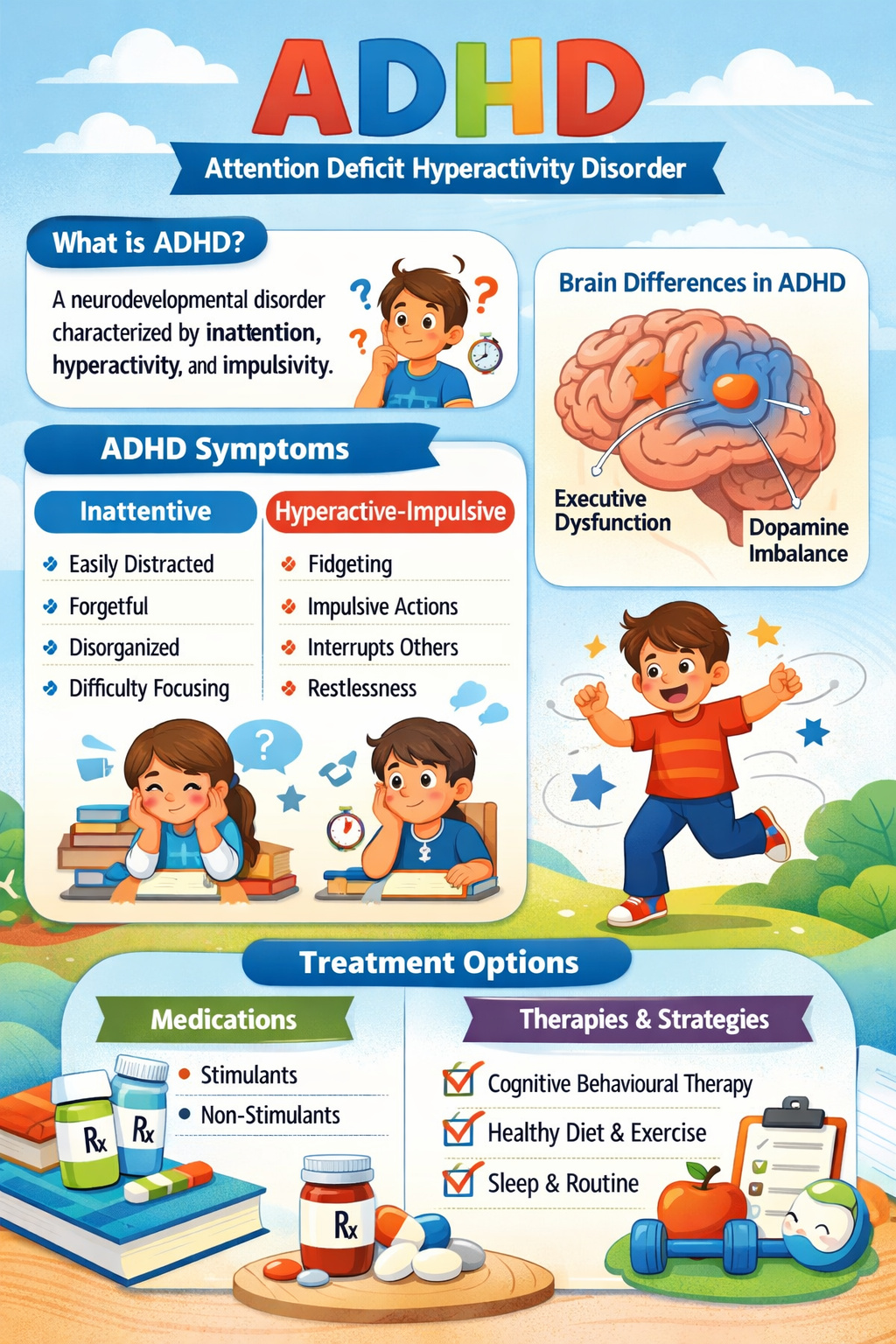
Inattention Symptoms (Based on DSM-5)
The inattention dimension includes:
Careless mistakes and poor attention to detail
Difficulty sustaining attention
Appears not to listen
Fails to finish tasks
Difficulty organizing tasks
Avoids tasks requiring sustained effort
Loses necessary items
Easily distracted
Forgetful in daily activities
Hyperactivity-Impulsivity Symptoms (Based on DSM-5)
The hyperactivity-impulsivity dimension includes:
Fidgeting or squirming
Leaving seat when expected to remain
Running or climbing excessively (or feeling restless in adults)
Difficulty engaging in activities quietly
“On the go” or driven by a motor
Talking excessively
Blurting answers
Difficulty awaiting turns
Interrupting or intruding on others
Rate each symptom across each setting using the 0-3 scale (0 = not present, 1 = mild, 2 = moderate, 3 = severe)
Identify patterns—which symptoms appear consistently across settings versus only in specific contexts
Calculate scores—the total scores for each dimension provide a summary of symptom burden
Share with a healthcare professional—this information can supplement clinical evaluation
Important: This checklist is a screening and tracking tool, not a diagnostic instrument. Only a qualified healthcare professional can diagnose ADHD through comprehensive clinical evaluation, including interviews, observation, and consideration of differential diagnoses .
How to Use This Checklist
Rate each symptom across each setting using the 0-3 scale (0 = not present, 1 = mild, 2 = moderate, 3 = severe)
Identify patterns—which symptoms appear consistently across settings versus only in specific contexts
Calculate scores—the total scores for each dimension provide a summary of symptom burden
Share with a healthcare professional—this information can supplement clinical evaluation
Important: This checklist is a screening and tracking tool, not a diagnostic instrument. Only a qualified healthcare professional can diagnose ADHD through comprehensive clinical evaluation, including interviews, observation, and consideration of differential diagnoses .
References
Kessler, R.C., Adler, L., Ames, M., et al. (2005). The World Health Organization Adult ADHD Self-Report Scale (ASRS). Psychological Medicine, 35, 245-256.
American Psychiatric Association. (2013). Diagnostic and Statistical Manual of Mental Disorders (5th ed.). Arlington, VA: American Psychiatric Publishing.
APA 2019 ADHD Guideline: Clinical Practice Guideline for the Diagnosis, Evaluation, and Treatment of Attention-Deficit/Hyperactivity Disorder (ADHD) in Children and Adolescents.
DuPaul, G.J., Power, T.J., Anastopoulos, A.D., & Reid, R. (2016). ADHD Rating Scale–5 for Children and Adolescents: Checklists, Norms, and Clinical Interpretation. Guilford Press.
DuPaul, G.J. (1990). The Home and School Situations Questionnaires—Revised: Normative Data, Reliability, and Validity. University of Massachusetts Medical Center.
European Child & Adolescent Psychiatry (2015). Contextual variability of ADHD symptoms: embracement not erasement of a key moderating factor. *24*, 1–4.