
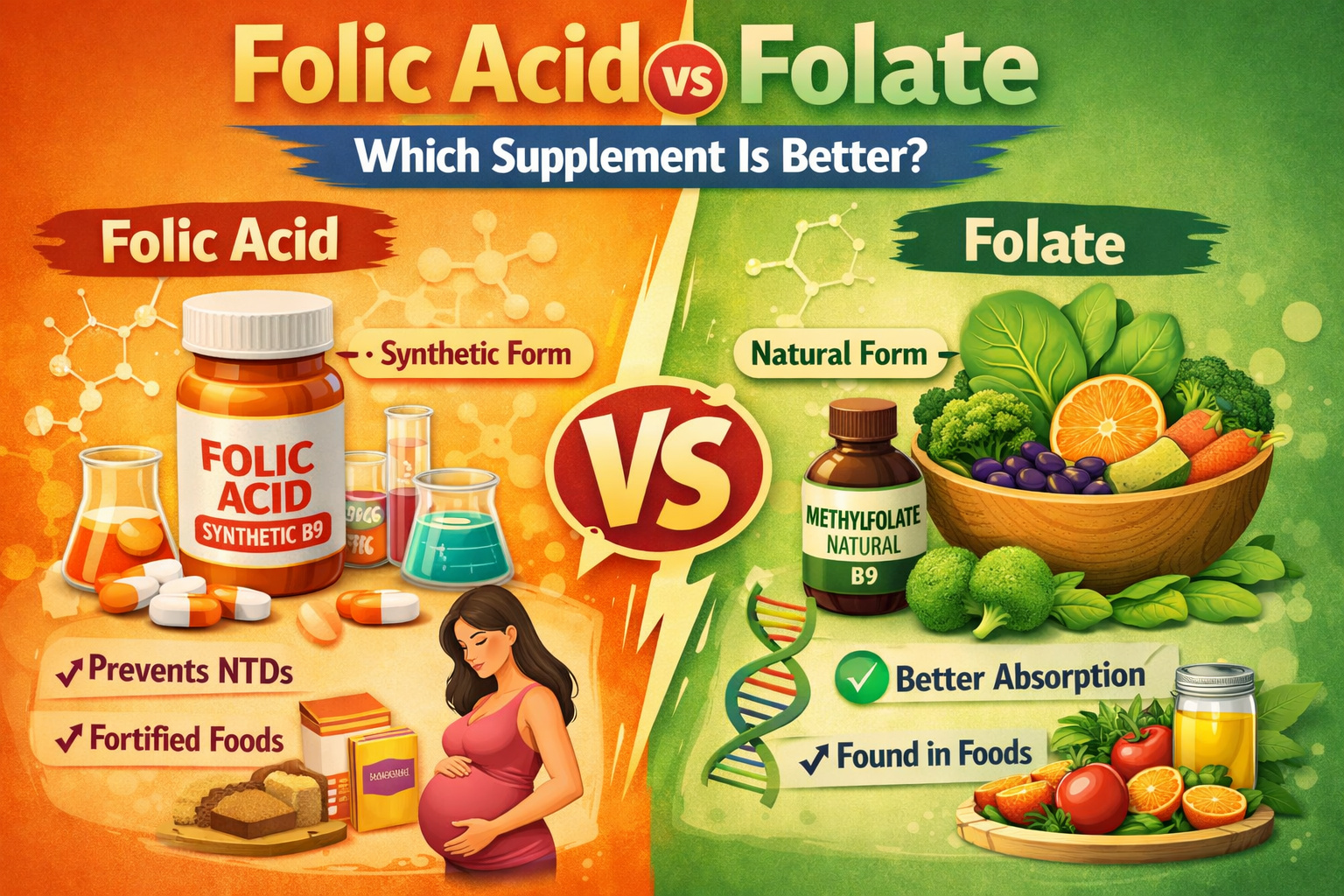

Medically reviewed by Dr. Rao Khurram Ayoub, RPh, PhD (Pharmaceutics)
Updated on
What's the Difference Between Folic Acid and Folate? (Synthetic vs Natural Forms Explained)

Folic Acid: The Synthetic Powerhouse
Folic acid is a synthetic, man-made version of vitamin B9 and it possesses a highly stable chemical structure, it does not degrade easily during food processing or storage. However, your body cannot use it immediately; your liver must first convert it through a complex, multi-step enzymatic process.
| Feature | Folic Acid (Synthetic) |
|---|---|
| Structure | Oxidized, monoglutamate, highly stable to heat/storage — ideal for fortification |
| Found In | Prenatal vitamins, fortified grains, cereals, supplements, bread |
| Activation | Requires 2-step reduction via DHFR enzyme: Folic Acid → Dihydrofolate → Tetrahydrofolate → Active 5-MTHF via MTHFR. Slow conversion, limited by DHFR capacity |
| Usage | Used for DNA synthesis & methylation only after conversion |
| Common Dose | 400-800mcg general, 5mg high-risk NTD |
Folate: The Natural Bioactive Form
Folate refers to the natural forms of vitamin B9 found natively in whole foods like leafy greens, legumes, and citrus fruits. The most active, bio-ready supplement form is 5-MTHF (methylfolate), which bypasses the liver's conversion steps entirely. It enters your bloodstream directly, making it instantly available for critical cellular repair and DNA synthesis.

Bioavailability Comparison (Methylfolate Wins for MTHFR) — Bypassing the MTHFR Genetic Mutation
Millions carry a variation in MTHFR gene, which severely impairs ability to convert synthetic folic acid into its active form. For these individuals, standard folic acid supplements are highly inefficient and can leave unmetabolised folic acid (UMFA) in blood. Methylfolate completely bypasses this genetic bottleneck, delivering active vitamin B9 straight to tissues regardless of genetic makeup.
• Prinz-Langenohl et al., 2009 stated that L-methylfolate exhibits significantly higher bioavailability than folic acid, especially in individuals with reduced MTHFR enzyme activity, because it does not require enzymatic conversion to enter metabolic cycle.
• Skavinska et al., 2025 stated that 5-MTHF, active form, is more efficiently utilised and avoids build-up of unmetabolised folic acid in bloodstream.
• Winkels et al., 2007: Bioavailability of food folates is 80% of that of folic acid — food folate 80% vs folic acid 100% relative, but methylfolate = 95-98% immediate.
• Samaniego-Vaesken et al., 2024: Supplementation with folic acid or 5-methyltetrahydrofolate and prevention of neural tube defects — both effective.
| Folic Acid | L-Methylfolate (5-MTHF) | |
|---|---|---|
| Biological Activity | No function until DHFR reduces it | Available for metabolism immediately following consumption |
| MTHFR Required? | Yes — DHFR → MTHFR → 5-MTHF | No — bypasses DHFR & MTHFR, ready to use no conversion needed |
| Bioavailability Typical MTHFR | ~50% effective due to conversion limit | ~98% direct |
| Bioavailability Reduced MTHFR Activity | ~20% — accumulates as UMFA | ~95% — higher bioavailability especially reduced MTHFR enzyme activity |
| UMFA Accumulation | Yes at >200-1000mcg/day | No — none |
Which Should You Choose by Life Stage? (Pregnancy, Elderly, General Users)
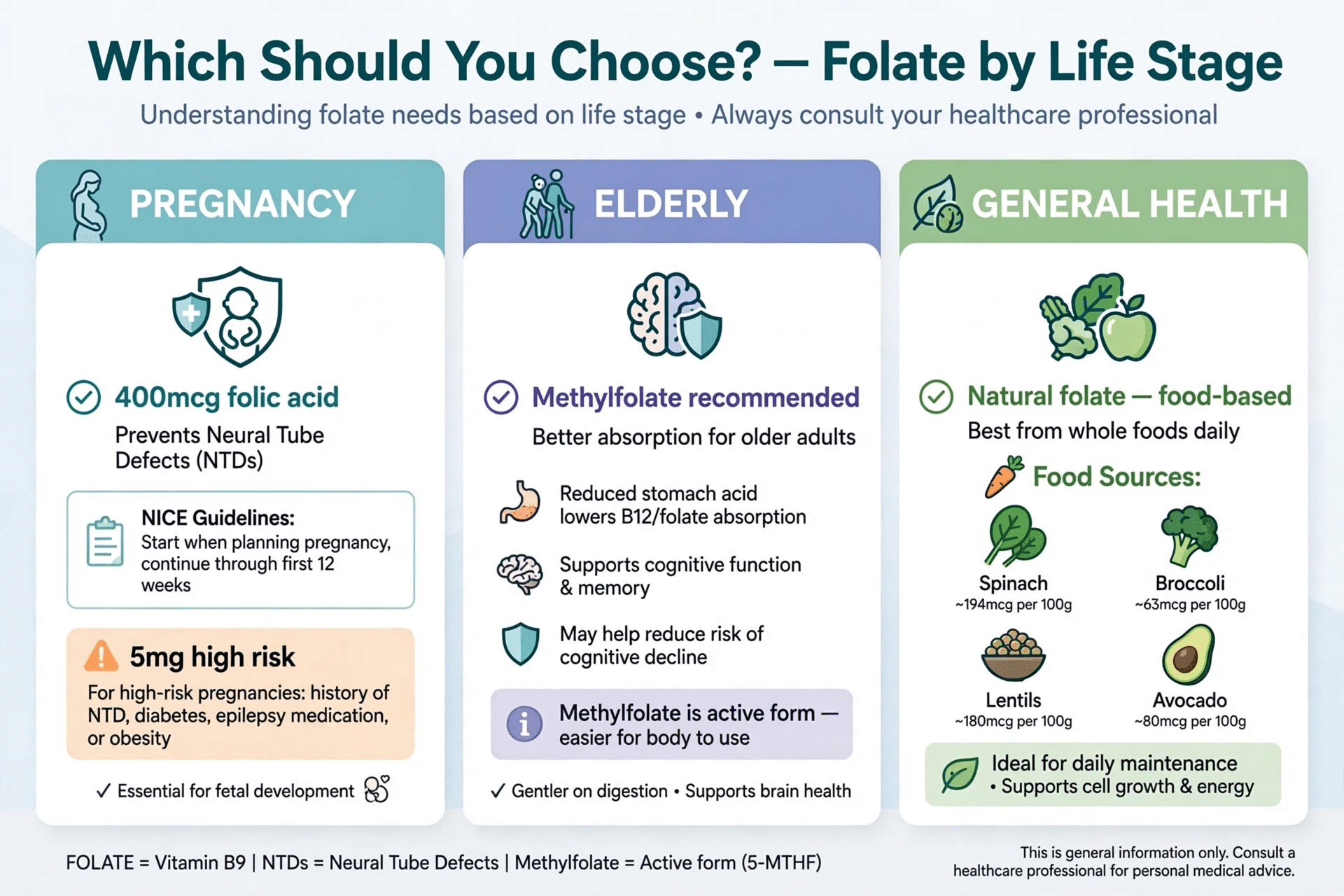
CDC: 400-800mcg • High-risk 4000-5000mcg
Active form supplementation might contribute to higher plasma folate, erythrocyte folate, and lower incidence adverse outcomes in women of childbearing age.
Elderly adults need 400–600 µg daily due to reduced absorption rates, supporting cognitive function and reducing stroke risk by 10–15% in older populations. Methylfolate effects on cognitive decline and dementia: protocol systematic review Prado et al 2023.
For day-to-day wellness without specific medical risks, getting your vitamin B9 from diet rich in natural folate is ideal. Loading plate with spinach, broccoli, lentils, avocados provides synergistic blend fibre, antioxidants, essential co-factors. Food-based folate maintains steady balanced nutrient levels without any risk synthetic buildup. Pentieva et al 2004: Short-term bioavailabilities of [6S]-5-methyltetrahydrofolate and folic acid are equivalent in men.
Price & Availability Worldwide
| Form | Price | Availability | Best For |
|---|---|---|---|
| Folic Acid | Cheap — low cost, $0.02-0.05 per 400mcg | Widely available, included in multivitamins fortified grains, prenatal vitamins | General fortification, short-term use <1000mcg, pregnancy prevention NTDs per NICE |
| Methylfolate (5-MTHF) | Expensive — higher cost, $0.15-0.40 per 400mcg | Increasingly accessible Europe North America, specialty supplement, limited availability | MTHFR variants, sensitive individuals, long-term use, elderly |
| Natural Folate Food | Moderate — cost of fresh produce | Abundant in fresh produce but less concentrated, rapidly destroyed by cooking storage | Day-to-day wellness, synergistic fibre antioxidants |
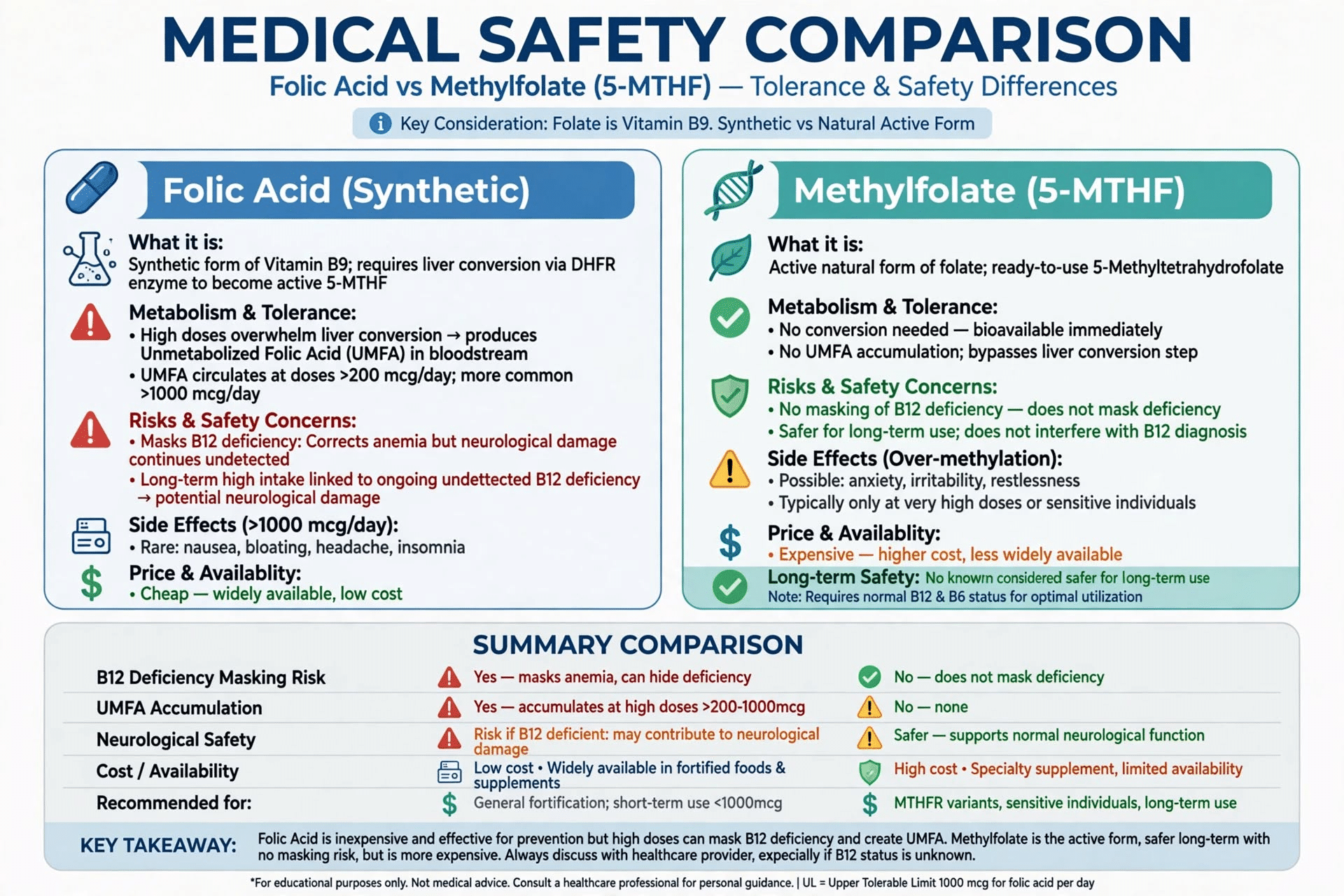
Side Effects & Safety Comparison: Folic Acid vs Folate Tolerance Differences
Consuming high doses synthetic folic acid can overwhelm liver's conversion capacity, leading to unmetabolised folic acid (UMFA) circulating in blood. Research suggests UMFA may hide vitamin B12 deficiency, potentially allowing permanent neurological damage to progress unnoticed. Methylfolate does not carry this masking risk, making it inherently safer choice for long-term high-dose supplementation.
| Safety Aspect | Folic Acid (Synthetic) | Methylfolate (5-MTHF) |
|---|---|---|
| B12 Masking Risk | Yes — masks anemia, can hide B12 deficiency, risk neurological damage if B12 deficient | No — does not mask deficiency, safer for long-term use does not interfere B12 diagnosis |
| UMFA Accumulation | Yes — accumulates at high doses >200-1000mcg, UMFA circulates >200mcg/day more common >1000mcg/day | No — none, no UMFA accumulation bypasses liver conversion |
| Neurological Safety | Risk if B12 deficient may contribute neurological damage | Safer — supports normal neurological function |
| Side Effects >1000mcg | Rare: nausea, bloating, headache, insomnia at doses >1000 µg | Fewer but may cause over-methylation (anxiety, irritability, restlessness) in sensitive people, typically only at very high doses |
| Overall Safety | Both safe at recommended doses, cheap widely available low cost | Both safe at recommended doses, methylfolate has fewer adverse effects, no known considered safer long-term, requires normal B12 & B6 status optimal utilization, UL = Upper Tolerable Limit 1000mcg folic acid per day |
FAQs
Yes, absolutely. Your body can seamlessly utilise methylfolate because it is already in active form, making it highly efficient option for anyone, regardless genetic status. Short-term bioavailabilities of [6S]-5-methyltetrahydrofolate and folic acid equivalent in men per Pentieva 2004, but methylfolate bypasses conversion.
While dietary folate excellent general health, cooking and food storage rapidly destroy it. Pregnant women should rely on targeted supplement to guarantee they hit strict daily targets required to prevent neural tube defects. NICE NG247 recommends 400mcg folic acid supplement for all women planning pregnancy and first 12 weeks. Active form supplementation might contribute higher plasma folate erythrocyte folate lower incidence adverse outcomes in women childbearing age.
You can naturally boost intake eating dark leafy greens (kale spinach), beef liver, asparagus, brussels sprouts, avocado, and protein-rich legumes such as chickpeas lentils. Found in: Leafy greens broccoli beans lentils avocado liver. Dietary sources spinach kale broccoli legumes. Bioavailability food folates is 80% of that folic acid per Winkels 2007.
Elderly need 400-600µg daily due reduced absorption rates supporting cognitive function reducing stroke risk 10-15% older populations. As stomach acid decreases digestive efficiency declines harder process synthetic vitamins. Methylfolate offers superior direct absorption protects nervous system without overworking sluggish metabolism.
Related Tools
- Folic acid complete guide benefits dosage safety : full benefits & food sources, natural folate polyglutamate vs synthetic monoglutamate
- Pregnancy due date calculator : when to start folate — start 1 month before conception through first 12 weeks per NICE
- Drugs contraindicated in pregnancy : folate safety in pregnancy drug safety alarm
- Vitamin B12 supplements : B12 masking risk with high folic acid
- Daily nutrient requirements calculator
References
2. Tate, C., Shuman, A., Nice, S. and Salehi, P. (2024) ‘The Critical Role of Folate in Prenatal Health and a Proposed Shift from Folic Acid to 5-Methyltetrahydrofolate Supplementation’, Georgetown Medical Review, 8(1). https://doi.org/10.52504/001c.124570.
3. Prinz-Langenohl, R. et al. (2009) ‘[6S]-5-methyltetrahydrofolate increases plasma folate more effectively than folic acid in women with homozygous or wild-type 677C→T polymorphism of MTHFR’, British Journal of Pharmacology, 158(8), pp. 2014-2021. https://doi.org/10.1111/j.1476-5381.2009.00492.x.
4. Winkels, R.M. et al. (2007) ‘Bioavailability of food folates is 80% of that of folic acid’, Am J Clin Nutr, 85(2), pp. 465-473. https://doi.org/10.1093/ajcn/85.2.465.
5. Prado, L.I.d.A. et al. (2023) ‘The Effects of Methylfolate on Cognitive Decline and Dementia: Protocol Systematic Review and Meta-Analysis’, J Clin Med, 12(9), p. 3075. https://doi.org/10.3390/jcm12093075.
6. Pentieva, K. et al. (2004) ‘Short-Term Bioavailabilities of [6S]-5-Methyltetrahydrofolate and Folic Acid Are Equivalent in Men’, J Nutr, 134(3), pp. 580-585. https://doi.org/10.1093/jn/134.3.580.
7. Skavinska, Rossokha et al., Comparative Analysis of Treatment With Folate Forms in Clinical Practice, Nutrition Reviews, 2025, nuaf216, https://doi.org/10.1093/nutrit/nuaf216
8. NICE NG247 Maternal and child nutrition: nutrition and weight management in pregnancy, and nutrition in children up to 5 years
9. Pinto X et al. Folate-rich diet as effective as folic acid from supplements in decreasing plasma homocysteine concentrations. Int J Med Sci 2005; 2(2):58-63. doi:10.7150/ijms.2.58.
10. Hecker J et al. Adverse Effects of Excessive Folic Acid Consumption and Implications for Individuals With MTHFR C677T Genotype. Cureus. 2025 Feb 20;17(2):e79374. doi: 10.7759/cureus.79374. PMID: 40130142; PMCID: PMC11930790.
11. Hecker et al., 2024 low folate alone can lead to depressive symptoms and can be further exacerbated by MTHFR mutation.