

Medically reviewed by Dr. Rao Khurram Ayoub, RPh, PhD (Pharmaceutics)
Written by Dr. Muhammad Imran, M.Phil, PharmD, BSc
Updated on
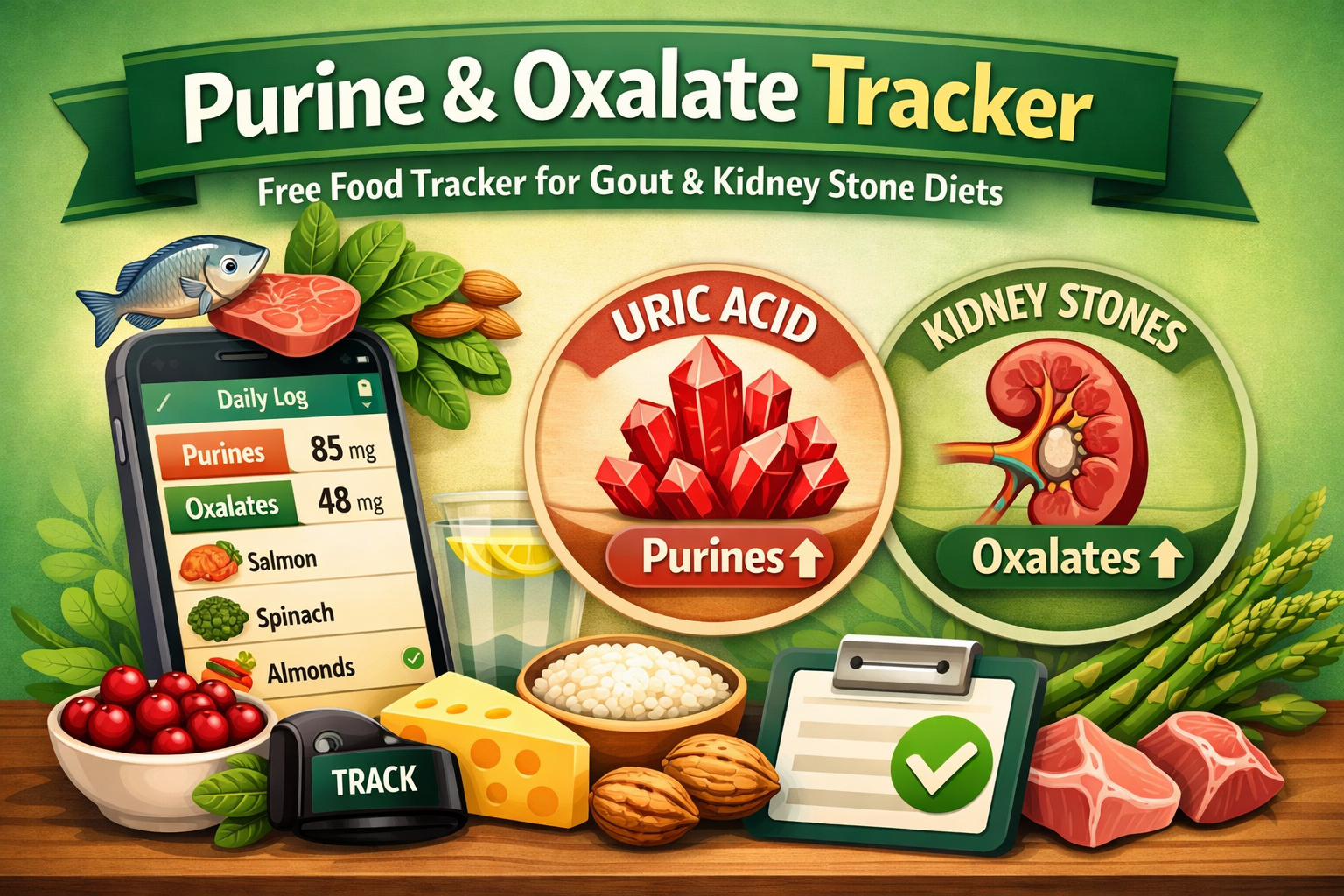
Purine & Oxalate Calculator – Search, Add, Get Total
Values approximate per Harvard oxalate + purine tables. Use band (low / moderate / high), not decimal. Nothing is saved.
Your Result Explained – Gout Target vs Kidney Stone Target
| Gout – Purine | Kidney Stones – Oxalate | |
|---|---|---|
| Daily Target | No fixed mg – aim low-purine day, urate <6 mg/dL on treatment | 40-50 mg oxalate / day if you form calcium oxalate stones |
| Per Meal – Low | <200 mg purine | <25 mg oxalate |
| Per Meal – High | ≥400 mg purine | ≥50 mg oxalate |
| Key Drink | Water 2-3 L, avoid alcohol / sugary drinks | Water 2-3 L, calcium WITH meals |
What Are Purines? What Are Oxalates?
Purines are natural compounds in food + body. Body breaks them → uric acid. Too much uric acid → MSU crystals → gout. Oxalates are natural compounds in plants. In gut, oxalate binds calcium → if calcium is low, oxalate is absorbed → in kidney, oxalate + calcium → calcium oxalate stones. That is why calcium with meals protects against stones.
Foods Low In BOTH Purine + Oxalate – Safe List
- Best: Water, milk, yogurt, cheese, eggs, rice, bread, cucumber, cauliflower, apple, banana, cherries, grapes
- Why: Purine <30 mg + Oxalate <5 mg per 100g – safe for both gout + stones
- Use: Build your plate around these, add 1 moderate food, not 2 high foods together
Foods High Oxalate, Low Purine – Spinach Trap
| Food | Purine / 100g | Oxalate / Serving | Rule |
|---|---|---|---|
| Spinach, cooked 1/2 cup | 19 mg – Low | 755 mg – Very High | Safe for gout, avoid if stones |
| Almonds 1 oz | 37 mg – Low | 122 mg – Very High | Safe for gout, avoid if stones |
| Beets 1/2 cup | 31 mg – Low | 152 mg – Very High | Safe for gout, avoid if stones |
| Black Tea 1 cup | 0 mg | 14 mg – Moderate | 1-2 cups OK, do NOT drink 5-6 cups if stones |
Foods High Purine, Low Oxalate – Meat Trap
| Food | Purine / 100g | Oxalate | Rule |
|---|---|---|---|
| Sardines | 480 mg – Very High | 0 mg | Avoid if gout, safe for stones |
| Kaleji / Liver | 219 mg – Very High | 1 mg | Avoid if gout, safe for stones |
| Chicken Breast | 167 mg – Moderate | 0 mg | 100-150g portion, 2-3x/week if gout |
| Beef / Mutton | 110-115 mg – Moderate | 1 mg | Limit if gout, safe for stones |
Full Purine + Oxalate Table – 30 Foods
Use calculator above for exact portion. Table = per 100g, approximate. Green = Low, Yellow = Moderate, Red = High.
| Food | Purine mg / 100g | Oxalate mg / Serving | Verdict |
|---|---|---|---|
| Spinach, cooked | 19 | 755 / 1/2 cup | OXALATE VERY HIGH |
| Almonds | 37 | 122 / 1 oz | OXALATE VERY HIGH |
| Sardines | 480 | 0 | PURINE VERY HIGH |
| Kaleji / Liver | 219 | 1 | PURINE HIGH |
| Chicken Breast | 167 | 0 | PURINE MODERATE |
| Beef / Mutton | 110 | 1 | PURINE MODERATE |
| Lentils / Dal | 31 | 8 / 1/2 cup | LOW BOTH |
| Egg | 3 | 0 | LOW BOTH |
| Milk / Yogurt | 3-7 | 1 | LOW BOTH + CALCIUM |
| Apple / Banana / Cherries | 7-14 | 2-3 | LOW BOTH |
Full 30 foods are in the calculator dropdown – search any food to see its exact purine + oxalate for your portion.
Pakistan / Desi Foods – Kaleji, Paya, Palak, Dal, Chai
- Kaleji (liver): Purine very high, oxalate low – worst for gout, safe for stones. Avoid if gout.
- Paya / Trotters: Purine moderate-high, oxalate low – limit if gout, 1 small plate, not weekly.
- Nihari / Haleem: Purine moderate-high, oxalate low – red meat + fat, limit if gout.
- Palak (spinach): Purine low, oxalate very high – safe for gout, avoid if kidney stones. Palak paneer is better than palak alone – paneer calcium binds oxalate.
- Dal (lentils): Purine low, oxalate low – safe for both. Plant purines do NOT raise gout risk like meat purines.
- Chai / Black Tea: Oxalate moderate – 1-2 cups with milk OK, 5-6 cups strong chai without milk = high oxalate load if stones.
- Almonds / Badam: Purine low, oxalate very high – 5-6 almonds OK, 1 handful (28g) = 122 mg oxalate – too much if stones.
Calcium Rule – Do NOT Cut Calcium
Wrong: “I have stones, so I will stop milk.” Right: Eat calcium with oxalate foods. Calcium in gut binds oxalate → oxalate leaves in stool, not kidney. Low calcium diet increases stone risk. Aim for normal calcium (1,000 mg/day from food) + low oxalate + high water.
How Much Purine / Oxalate Per Day?
- Oxalate: Normal person: 100-200 mg/day OK. Stone former: 40-50 mg/day
- Purine: No official daily mg – focus on urate <6 mg/dL + low-purine pattern + no alcohol / organ meat / sardines
- Water: 2-3 L/day – most important for both gout + stones
- Salt: Limit – high salt increases calcium in urine → stones
FAQ – Purine & Oxalate Calculator
How to calculate purine in food per day?
Search each food in calculator above, set portion in grams, click Add. It sums purine + oxalate for your meal. Do it for 3 meals = daily total.
How much oxalate per day for kidney stones?
40-50 mg/day if you form calcium oxalate stones. One 1/2 cup spinach (755 mg) is 15x daily limit.
Is spinach bad for gout?
No – spinach is low-purine, safe for gout. It is bad for kidney stones because oxalate is very high.
Are almonds bad for gout or kidney stones?
Almonds are low-purine (safe for gout) but very high oxalate (122 mg / oz) – avoid if stones, limit to 5-6 nuts.
What foods are low in both purine and oxalate?
Eggs, milk, yogurt, cheese, rice, bread, cucumber, cauliflower, apple, banana, cherries – see Safe List above.
Should I cut calcium if I have kidney stones?
No – eat normal calcium with meals. Calcium binds oxalate in gut and protects against stones. Low calcium increases stones.
Can I eat dal if I have gout?
Yes – dal is low purine + low oxalate, plant purines do not raise gout risk like meat purines.
Is chai bad for kidney stones?
1-2 cups with milk OK. Strong black tea, 5-6 cups/day, without milk = high oxalate load if stones.
References
- [Ferraro et al., 2017]. Dietary Intake and Risk of Kidney Stones. American Journal of Kidney Diseases, 70, pp.1-10. DOI: 10.1053/j.ajkd.2017.03.010
- [FitzGerald et al., 2020]. 2020 American College of Rheumatology Guideline for the Management of Gout. Arthritis Care & Research, 72(6), pp.744-760. DOI: 10.1002/acr.24180
- [Kaneko et al., 2014]. Total purine and purine base content of common foodstuffs for facilitating nutritional therapy for gout and hyperuricemia. Biological & Pharmaceutical Bulletin, 37(5), pp.709-721. DOI: 10.1248/bpb.b13-00967
- [Ferraro et al., 2017]. Dietary and Lifestyle Risk Factors Associated with Incident Kidney Stones in Men and Women. The Journal of Urology, 198(4), pp.858-863. DOI: 10.1016/j.juro.2017.03.133
- [Mitchell et al., 2019]. Dietary oxalate and kidney stone formation. American Journal of Physiology-Renal Physiology, 316(3), pp.F409-F413. DOI: 10.1152/ajprenal.00373.2018
- Harvard T.H. Chan School of Public Health Nutrition Department. (2023). Oxalate Content of Foods (Database Tables). hsph.harvard.edu/nutritionsource/
- University of Chicago Kidney Stone Program. (2024). How To Eat A Low Oxalate Diet (Clinical Nutrition Guide). kidneystones.uchicago.edu
Author: Dr. Muhammad Imran, Pharm.D (Rph) | Reviewed by Dr. Rao Khurram Ayoub PhD | Updated: Nov 2026 | Educational only, not medical advice.