

Medically reviewed by Dr. Rao Khurram Ayoub, RPh, PhD (Pharmaceutics)
Written by Dr. Muhammad Imran, M.Phil, PharmD, BSc
Updated on
Table of Contents
Semaglutide is a GLP-1 receptor agonist used for type 2 diabetes and chronic weight management. It works by slowing stomach emptying, reducing appetite, improving insulin sensitivity, and increasing feelings of fullness.
Because food stays in the stomach for longer, many people eat less and lose weight over time. This delayed gastric emptying is also why semaglutide can cause nausea, bloating, sulfur burps, acid reflux, constipation, and feelings of fullness.
Semaglutide is available as:
- Ozempic
- Wegovy
- Rybelsus
Research has shown that semaglutide can help improve A1C levels, reduce body weight, lower cardiovascular risk, and improve obesity-related conditions such as fatty liver disease and sleep apnoea.
Common Semaglutide Side Effects
The most common semaglutide side effects are digestive symptoms.
These include:
- Nausea
- Vomiting
- Constipation
- Diarrhoea
- Acid reflux
- Sulfur burps
- Bloating
- Fatigue and weakness
- Sweating
- Dizziness
- Reduced appetite
- Bad breath
Most people notice that symptoms are worse during the first few weeks or after a dose increase.
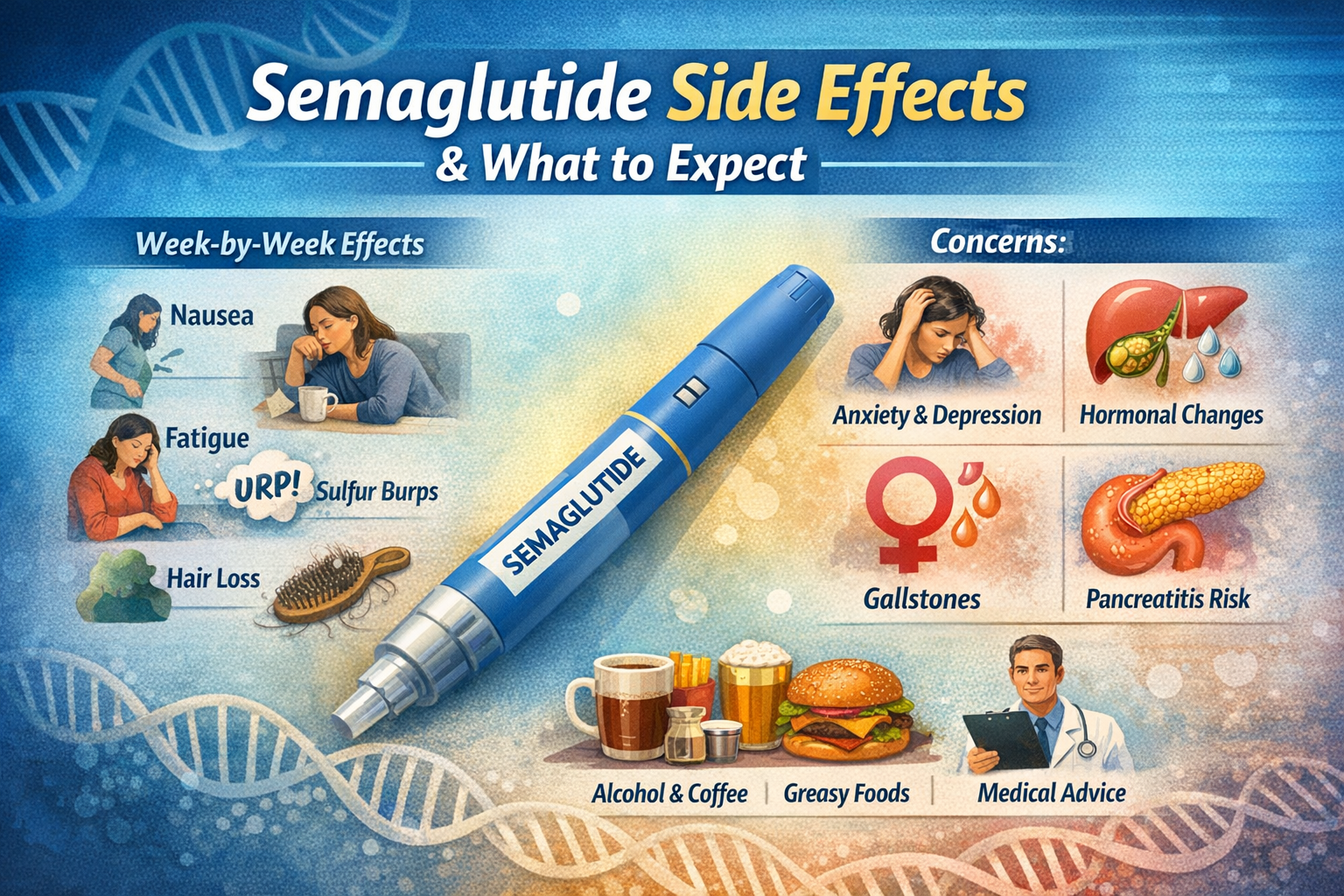
Semaglutide Side Effects Week by Week
Semaglutide side effects first week are usually mild but noticeable.
Week 1 to 2:
- Mild nausea
- Feeling full quickly
- Reduced appetite
- Fatigue
- Mild constipation
- Mild dizziness
Week 3 to 4:
- Sulfur burps
- Bloating
- Acid reflux
- Food aversion
- Sweating
- Bad breath
After dose increases:
- Worse nausea
- More bloating
- Increased fatigue
- Temporary weakness
- Headaches
- Constipation or diarrhoea
Semaglutide side effects after dose increase often settle within a few days to two weeks.
Why Do I Feel Tired on Semaglutide?
Semaglutide fatigue and weakness can happen for several reasons.
You may be eating less food than usual, drinking less water, or consuming fewer carbohydrates. This can leave you feeling tired, weak, dizzy, or mentally foggy.
Fatigue can also happen because:
- Rapid weight loss lowers calorie intake
- Nausea reduces food intake
- Dehydration becomes more common
- Sleep quality may worsen
- Low blood sugar can develop in people taking insulin or sulfonylureas
I often suggest focusing on protein, regular meals, hydration, and adequate sleep. Many people feel better when they increase water intake and eat smaller, balanced meals.
Why Do I Have Sulfur Burps on Semaglutide?
Semaglutide sulfur burps are a common complaint online. They usually happen because semaglutide slows stomach emptying.
Food stays in the stomach for longer, which may increase fermentation and gas production. This can cause:
- Sulfur burps
- Bad breath
- Bloating
- Acid reflux
- Stomach discomfort
Greasy foods, large meals, fizzy drinks, alcohol, onions, garlic, and fried foods can make sulfur burps worse.
Serious Side Effects of Semaglutide
Most semaglutide side effects are mild, but some can be serious.
Can Semaglutide Cause Pancreatitis, Gallstones, and Bowel Obstruction?
Semaglutide and pancreatitis risk is an important concern.
Pancreatitis is inflammation of the pancreas. Symptoms may include:
- Severe upper abdominal pain
- Pain that spreads to the back
- Vomiting
- Fever
- Persistent nausea
Semaglutide and gallstones are also linked because rapid weight loss may increase the risk of gallbladder disease.
Symptoms of gallstones may include:
- Right-sided abdominal pain
- Nausea
- Fever
- Pain after fatty meals
Semaglutide and bowel obstruction are rare but possible because delayed gastric emptying may contribute to severe constipation or intestinal blockage.
Can Semaglutide Cause Blurry Vision and Eye Damage?
Semaglutide and blurry vision can happen in some people, especially those with diabetes.
Rapid improvements in blood sugar can temporarily affect vision. Semaglutide and eye damage are mainly a concern for people with diabetic retinopathy.
Symptoms to watch for include:
- Blurry vision
- Floaters
- Dark spots
- Sudden changes in eyesight
Anyone with diabetic retinopathy should have regular eye checks while taking semaglutide.
Can Semaglutide Damage Kidneys?
Semaglutide can damage kidneys indirectly if vomiting, diarrhoea, or dehydration become severe.
People who already have kidney disease should be especially careful about staying hydrated.
Semaglutide and Mental Health
Can Semaglutide Cause Anxiety Attacks or Depression?
Semaglutide and anxiety are becoming more widely discussed.
Some people report feeling anxious, irritable, restless, or emotionally flat while taking semaglutide. Others ask whether semaglutide can make you depressed.
Current research has not proven that semaglutide directly causes depression or anxiety attacks, but low calorie intake, dehydration, sleep disruption, rapid weight loss, and hormone changes may contribute.
Semaglutide and sleep problems can also make anxiety worse.
People sometimes report:
- Trouble falling asleep
- Restless sleep
- Vivid dreams
- Waking up during the night
Semaglutide and Hormones
Can Semaglutide Affect Periods?
Semaglutide and menstrual changes are a growing topic online.
Weight loss, reduced calorie intake, and hormonal shifts may affect periods.
Some women notice:
- Missed periods
- Heavier bleeding
- Lighter bleeding
- Irregular cycles
- More ovulation symptoms
Semaglutide and Fertility
Semaglutide and fertility are closely linked because weight loss may improve ovulation and insulin resistance in women with PCOS.
Some women become more fertile after losing weight, which is why contraception is important if pregnancy is not planned.
Semaglutide and Erectile Dysfunction, Libido, and Testosterone
Semaglutide and erectile dysfunction concerns are common among men.
There is no strong evidence that semaglutide directly causes erectile dysfunction. However, low calorie intake, fatigue, anxiety, low testosterone, or rapid weight loss may affect libido.
Some men notice:
- Lower sex drive
- Temporary erectile difficulties
- Changes in testosterone levels
- Reduced energy
Semaglutide and Food Interactions
Can I Drink Alcohol While Taking Semaglutide?
Semaglutide and alcohol can be difficult for some people.
Alcohol may worsen:
- Nausea
- Dizziness
- Vomiting
- Dehydration
- Low blood sugar
- Acid reflux
Can I Drink Coffee on Semaglutide?
Semaglutide and coffee can sometimes worsen nausea, acid reflux, bloating, and sulfur burps.
Coffee may be easier to tolerate when:
- Drunk after food
- Limited to one cup
- Avoided during periods of nausea
What Foods Make Semaglutide Nausea Worse?
Semaglutide and greasy foods are often a bad combination.
Foods that may worsen symptoms include:
- Fried foods
- Fast food
- Greasy meals
- Spicy foods
- Fizzy drinks
- Alcohol
- Large portions
- Very sugary foods
Why Am I Not Losing Weight on Semaglutide After 3 Months?
Many people ask why semaglutide is not working anymore.
Weight loss may slow because:
- Portion sizes are still too large
- Liquid calories are being overlooked
- Exercise levels are low
- Sleep is poor
- Protein intake is low
- The dose is too low
- Weight loss plateaus are happening naturally
Semaglutide not working anymore does not always mean treatment has failed. Sometimes people need more time, better nutrition, strength training, or dose adjustment.
What Happens If You Stop Semaglutide?
Semaglutide withdrawal symptoms usually involve rebound hunger, stronger cravings, and weight regain.
Semaglutide rebound weight gain can happen because appetite returns once the medicine leaves the body.
People may notice:
- More hunger
- Less fullness after meals
- Weight gain
- Increased cravings
- Higher blood sugar
Semaglutide Hair Loss, Loose Skin, and Muscle Loss
Semaglutide hair loss before and after photos are common online.
Hair thinning usually happens because of rapid weight loss, reduced calorie intake, low protein intake, or stress.
Semaglutide and loose skin are also common concerns, especially after major weight loss.
Semaglutide muscle loss can happen if people lose weight without eating enough protein or doing strength training.
To reduce loose skin and muscle loss:
- Eat more protein
- Do resistance exercise
- Stay hydrated
- Lose weight gradually where possible
Semaglutide Before Surgery and Anaesthesia
Semaglutide and surgery planning is important because the medicine slows stomach emptying.
Many doctors recommend stopping semaglutide before surgery or anaesthesia to reduce the risk of vomiting or aspiration.
The exact timing depends on the procedure and the type of semaglutide being used.
FAQ
How Long Do Semaglutide Side Effects Last?
Most semaglutide side effects improve within a few days to a few weeks.
What Happens If I Miss a Semaglutide Injection?
If you miss a semaglutide injection, take it as soon as possible within five days. If more than five days have passed, skip the missed dose.
How Long Does Semaglutide Stay in Your System?
Semaglutide can stay in the body for several weeks because it has a long half-life.
References
Marso, S.P., Daniels, G.H., Brown-Frandsen, K., Kristensen, P., Mann, J.F.E., Nauck, M.A., Nissen, S.E., Pocock, S., Poulter, N.R., Ravn, L.S., Steinberg, W.M., Stockner, M., Zinman, B., Bergenstal, R.M. and Moses, A.C. (2018) ‘Liraglutide and Semaglutide: Diabetic Retinopathy and Cardiovascular Outcomes’, Diabetes Care, 41(2), pp. e17–e19. Available at: https://diabetesjournals.org/care/article/41/2/e17/36536/Liraglutide-and-Semaglutide-Cardiovascular
Wilding, J.P.H., Batterham, R.L., Calanna, S., Davies, M., Van Gaal, L.F., Lingvay, I., McGowan, B.M., Rosenstock, J., Tran, M.T.D., Wadden, T.A., Wharton, S., Yokote, K., Zeuthen, N. and Kushner, R.F. (2021) ‘Once-Weekly Semaglutide in Adults with Overweight or Obesity’, New England Journal of Medicine, 384(11), pp. 989–1002. Available at: https://pubmed.ncbi.nlm.nih.gov/33567185/
Lincoff, A.M., Brown-Frandsen, K., Colhoun, H.M., Deanfield, J., Emerson, S.S., Esbjerg, S., Hardt-Lindberg, S., Hovingh, G.K., Kahn, S.E., Kushner, R.F., Lingvay, I., Oral, T.K., Michelsen, M.M., Plutzky, J., Tornøe, C.W. and Ryan, D.H. (2023) ‘Semaglutide and Cardiovascular Outcomes in Obesity without Diabetes’, New England Journal of Medicine, 389(24), pp. 2221–2232. Available at: https://pubmed.ncbi.nlm.nih.gov/37952131/
Rubino, D., Abrahamsson, N., Davies, M., Hesse, D., Greenway, F.L., Jensen, C., Lingvay, I., Mosenzon, O., Rosenstock, J., Rubio, M.A., Rudofsky, G., Tadayon, S., Wadden, T.A. and Dicker, D. (2021) ‘Effect of Continued Weekly Subcutaneous Semaglutide vs Placebo on Weight Loss Maintenance in Adults With Overweight or Obesity’, JAMA, 325(14), pp. 1414–1425. Available at: https://jamanetwork.com/journals/jama/fullarticle/2777886
Marso, S.P., Bain, S.C., Consoli, A., Eliaschewitz, F.G., Jódar, E., Leiter, L.A., Lingvay, I., Rosenstock, J., Seufert, J., Warren, M.L., Woo, V., Hansen, O., Holst, A.G., Pettersson, J. and Vilsbøll, T. (2016) ‘Semaglutide and Cardiovascular Outcomes in Patients with Type 2 Diabetes’, New England Journal of Medicine, 375(19), pp. 1834–1844. Available at: https://www.nejm.org/doi/full/10.1056/NEJMoa1607141