

Medically reviewed by Dr. Rao Khurram Ayoub, RPh, PhD (Pharmaceutics)
Written by Dr. Muhammad Imran, M.Phil, PharmD, BSc
Updated on
🧠 Anticholinergic Cognitive Burden (ACB) Matrix
Quantify cumulative anticholinergic exposure to evaluate and mitigate the risk of cognitive impairment, falls, and central nervous system adverse effects.
💊 Medication Selection Panel
Add all current systemic medications from the clinical validation tiers below:
Current Patient Regimen
- No medications added yet. Regimen is clear.
No Identified Burden
Add systemic medications to calculate cumulative neurocognitive risk stratification metrics.
⚡ Automated Clinical Risk Analysis
Please enter a current pharmaceutical profile to evaluate drug-induced cognitive parameters and competitive central receptor suppression levels.
Understanding the Anticholinergic Cognitive Burden (ACB) Scale
The Pathophysiological Basis of Anticholinergic Burden
Anticholinergic medications work by competitively blocking acetylcholine from binding to muscarinic receptors ($M_1$ through $M_5$) throughout the central and peripheral nervous systems. In older adults, this blockade introduces significant clinical complications due to age-related changes in pharmacokinetics and pharmacodynamics, including:
Increased blood-brain barrier permeability.
Accelerated decline in baseline cholinergic neurons.
Reduced hepatic or renal clearance capabilities.
When multiple low-potency agents are taken together, or a single high-potency agent is introduced, the cumulative receptor blockade creates an Anticholinergic Cognitive Burden.
Decoding the ACB Scoring Framework
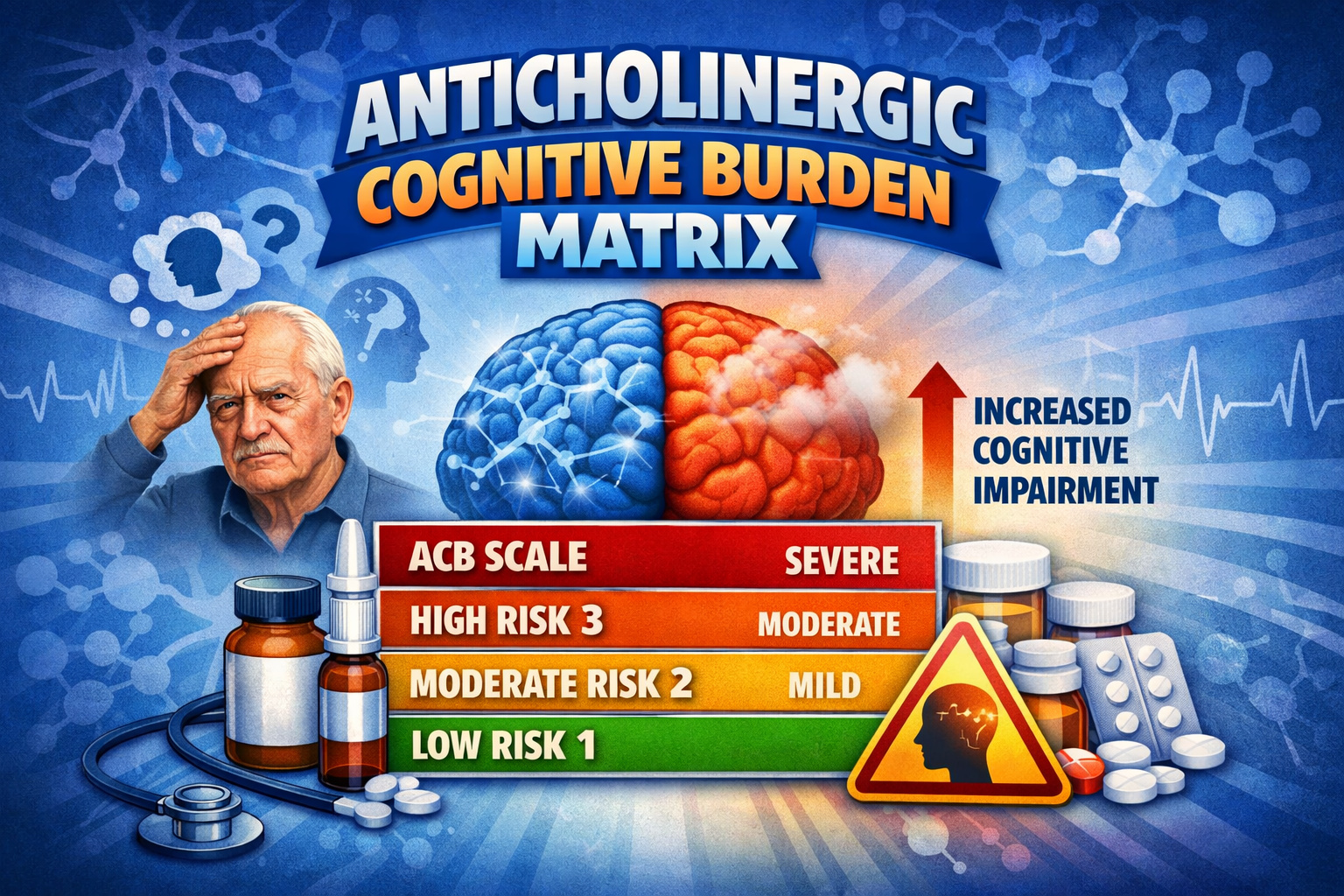
The tool utilizes the clinically validated scoring matrix developed by Boustani et al. to break down medications into three risk tiers:
Score 1 (Mild / Possible Burden): Medications that show anti-muscarinic activity in in-vitro serum assays but rarely cause clear cognitive side effects when used alone at standard doses (e.g., Furosemide, Alprazolam, Cetirizine).
Score 2 (Moderate Burden): Medications where central adverse events are occasionally documented in clinical trials, usually at elevated serum concentrations (e.g., Cyclobenzaprine, Carbamazepine).
Score 3 (Severe / Definite Burden): Highly potent agents with strong affinity for central muscarinic receptors. These medications are strongly linked to acute cognitive impairment and delirium (e.g., Amitriptyline, Oxybutynin, Diphenhydramine).
Clinical Interpretations & Interventions
Cumulative Score of 1 to 2: Linked to a 20-25% increased risk of cognitive decline. Recommendation: Monitor the patient closely and avoid adding further anticholinergic medications.
Cumulative Score of $\ge$ 3: Strongly associated with an increased risk of falls, acute confusion, and a 50% higher risk of developing clinical dementia over time. Recommendation: Initiate structured de-prescribing protocols, taper off high-scoring agents, and transition to safer therapeutic alternatives.
Refrences
American Geriatrics Society Beers Criteria Update Expert Panel, 2023. American Geriatrics Society Beers Criteria for potentially inappropriate medication use in older adults. Journal of the American Geriatrics Society, 71(7), pp. 2052–2081. Available at: https://doi.org/10.1111/jgs.18372.
Boustani, M., Campbell, N., Munger, S., Maidment, I. and Fox, C., 2011. Impact of anticholinergic cognitive burden scale on long-term cognitive impairment and mortality in older adults. Journal of the American Geriatrics Society, 59(suppl 1), p. S245.
Coupland, C.A., Hill, T., Dening, T., Morriss, R., Moore, M. and Hippisley-Cox, J., 2019. Anticholinergic drug exposure and the risk of dementia: a nested case-control study. JAMA Internal Medicine, 179(8), pp. 1085–1093. Available at: https://doi.org/10.1001/jamainternmed.2019.0677.
Fox, C., Richardson, K., Maidment, I.D., Savva, G.M., Matthews, F.E., Smithard, D., Coulton, S., Edwards, C., Byron, H.A., Purandare, N. and Finch, E., 2011. Anticholinergic medication use and cognitive impairment in the older population: the medical research council cognitive function and ageing study. Journal of the American Geriatrics Society, 59(8), pp. 1477–1483. Available at: https://doi.org/10.1111/j.1532-5415.2011.03491.x.