

Medically reviewed by Dr. Arham Shabbir, PhD (Pharmacology), M.Phil (Pharmacology), B.Pharm (RPh)
Written by Dr. Muhammad Imran, M.Phil, PharmD, BSc
Updated on
Table of Contents
Introduction: Distinguishing Clinical Anxiety from Baseline Physiological Stress
Experiencing a rapid pulse before a presentation is a normal stress response. However, when persistent worry alters your daily life, you cross the threshold into a formal clinical anxiety disorder.
DSM-5 Threshold Indices for Diagnosing GAD
To receive a formal diagnosis of Generalized Anxiety Disorder (GAD), you must experience excessive, uncontrollable worry about multiple everyday events for at least six months. This persistent worry must occur alongside at least three physical or cognitive symptoms, such as muscle tension, irritability, or severe sleep disturbances. A study by Bandelow et al., 2017 stated that strict adherence to DSM-5 diagnostic criteria is essential to accurately separate subclinical daily stress from chronic generalized anxiety disorder.
The Neurobiological Blueprint: How Neurotransmitter Vectors Alter Brain Signaling
Your brain relies on a highly delicate balance of chemical messengers to process stress. When you suffer from chronic panic, specific neurotransmitter pathways become deeply impaired, altering how your brain cells talk to one another.
The Amygdala and GABA-A Receptor Imbalances
Chronic fear over-activates your amygdala, the brain’s main emotional radar, while simultaneously lowering your calming GABA-A receptor sensitivity. This specific chemical drop removes your nervous system’s natural brakes, leaving you stuck in a continuous state of exhausting hyperarousal. A study by Nuss, 2015 stated that deficiencies in GABA neurotransmission disrupt the brain’s ability to damp down amygdala hyperarousal, directly driving the physical symptoms of severe panic.
A study by Herman et al., 2021 stated that chronic stress causes circuit-specific remodeling of the basolateral amygdala, which directly increases anxiety-like behaviours and vulnerability to mood disorders.
Clinical Classifications of Anxiety Pathology
Medical professionals divide persistent worry into specific clinical classifications. Identifying these unique presentation patterns helps us select the most effective therapeutic strategies for long-term recovery.
Generalized Anxiety Disorder (GAD)
Generalized Anxiety Disorder causes a continuous, non-specific background worry regarding routine daily responsibilities like finances, health, or family safety. This constant mental overload creates a perpetual state of cognitive fatigue and physical exhaustion. A study by Bandelow et al., 2017 stated that GAD presents as a pervasive, unprovoked anxiety that severely impairs a patient’s social and occupational functioning over extended periods.
Panic Disorder and Agoraphobia Trajectories
Panic Disorder strikes as sudden, unprovoked waves of paralyzing fear, which can easily progress into agoraphobia if you begin avoiding public spaces. These intense surges cause severe physical reactions, forcing individuals to alter their daily routines out of fear of another attack. A study by Craske et al., 2017 stated that panic disorder frequently causes secondary agoraphobia as individuals develop a learned avoidance of environments associated with previous panic attacks.
Social Anxiety Disorder (SAD) Specific Triggers
Social Anxiety Disorder activates an intense, rational fear of being judged, humiliated, or negatively scrutinized during routine public interactions. This distressing condition turns simple tasks, like eating in public or speaking in a meeting, into overwhelming hurdles. A study by Stein and Stein, 2015 stated that SAD creates profound social impairment because common interpersonal settings trigger an immediate, intense autonomic fear response.
Somatic Manifestations: The Physical Toll of Autonomic Nervous System Hyperactivity
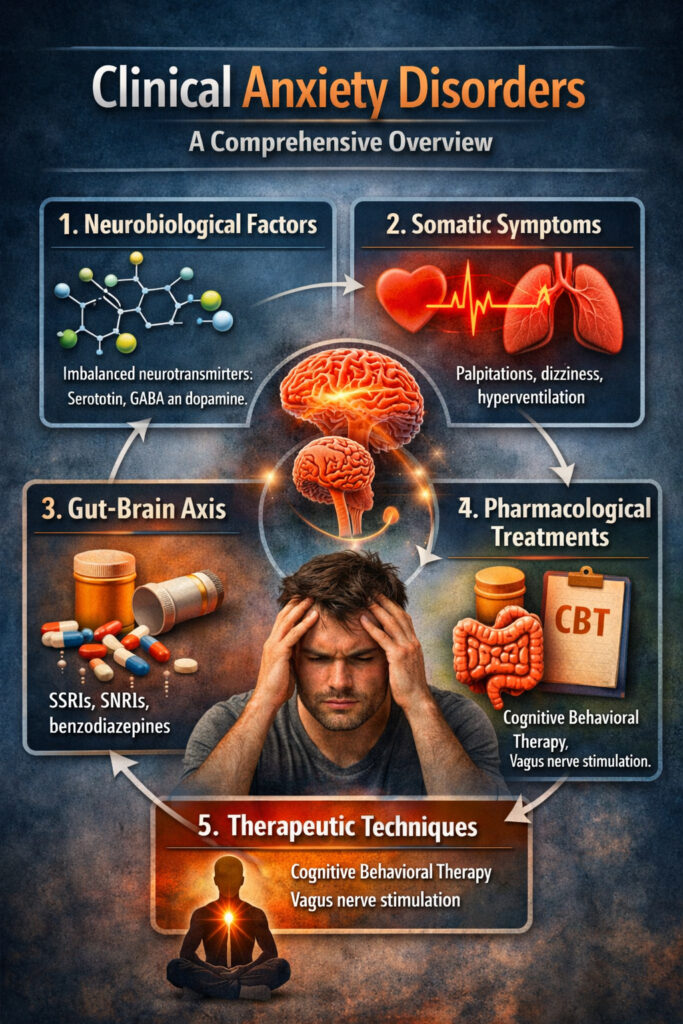
Chronic panic is not just a mental burden; it inflicts a real physical toll on your body. When your mind senses danger, it triggers involuntary survival mechanisms that alter your cardiovascular and respiratory functions.
Cardiovascular Alterations and Vagal Tone Suppression
Persistent nervous system hyperarousal suppresses your natural vagal tone, causing your heart rate to spike and your blood vessels to constrict. This physical tension often creates sharp chest wall pains that patients easily mistake for a serious cardiac event. A study by Chalmers et al., 2014 stated that anxiety disorders are characteristically associated with a significant reduction in heart rate variability, showing poor vagal nerve control.
Respiratory Hyperventilation and Respiratory Alkalosis
Rapid, shallow breathing during acute panic blows off too much carbon dioxide, causing a rapid shift into temporary respiratory alkalosis. This sudden change in your blood pH reduces local blood flow to your brain, creating immediate dizziness and tingling sensations. A study by Meuret et al., 2011 stated that hyperventilation during panic states alters blood gas parameters, triggering respiratory alkalosis and intensifying a patient’s physical distress.
The Gut-Brain Axis: Intestinal Permeability and Enteric Microenvironment Shifts
Your digestive tract and your brain maintain a constant, complex dialogue. When your mind is under constant strain, it sends direct chemical distress signals down to your digestive system.
Epithelial Barrier Breakdown and Local Inflammatory Cascades
Elevated stress hormones disrupt your intestinal epithelial barrier, causing increased gut permeability and altering your protective enteric microbiome. This structural breakdown triggers local inflammatory cascades, resulting in the painful bloating, cramping, and nausea often reported during high-stress periods. A study by Clapp et al., 2017 stated that bi-directional communication along the gut-brain axis allows emotional distress to fundamentally alter gut microbiota composition and mucosal integrity.
A study by Nikolova et al., 2021 stated that targeted modulation of the gut microbiome significantly improves symptoms in anxiety and depression, highlighting the role of local inflammatory cascades.
Pharmacological Interventions: Balancing Serotonin Transporters and Receptor Dynamics
When lifestyle adjustments are not enough, we use targeted pharmaceutical therapies to bring your brain chemistry back into a healthy, stable balance.
SSRI Kinetic Profiles and Post-Synaptic Receptor Regulation
Selective Serotonin Reuptake Inhibitors (SSRIs) block your presynaptic serotonin transporters, gradually increasing the concentration of chemical messengers in your synapses. This continuous increase forces your post-synaptic receptors to normalize over several weeks, stabilizing your overall mood. A study by Gartlehner et al., 2016 stated that SSRIs act as effective first-line tools by steadily correcting serotonin signaling imbalances within synaptic pathways.
A study by Garakani et al., 2020 stated that SSRIs remain the first-line pharmacotherapy for anxiety disorders due to their favourable kinetic profiles and ability to safely regulate post-synaptic receptor dynamics over time.
SNRI Mechanisms and Dual-Neurotransmitter Reuptake Inhibition
Serotonin-Norepinephrine Reuptake Inhibitors (SNRIs) simultaneously block both serotonin and norepinephrine transporters to increase the availability of both chemical messengers. This dual action is highly beneficial for patients who experience severe physical fatigue and muscle pain alongside persistent worry. A study by Gartlehner et al., 2016 stated that dual-acting SNRIs manage severe panic symptoms by modulating multiple monoamine pathways to restore overall signaling balance.
Short-Term Anxiolytics: The Role of Benzodiazepine Allosteric Modulation
Benzodiazepines act as positive allosteric modulators at the GABA-A receptor complex, instantly amplifying your brain’s natural calming mechanisms. While they provide rapid relief during an acute crisis, I strictly limit their use to short periods to prevent physical tolerance and dependency. A study by Baldwin et al., 2014 stated that the use of benzodiazepines must be strictly time-limited due to the rapid development of tissue tolerance.
Evidence-Based Self-Regulation: Clinical Vagus Nerve Stimulation and Somatic Grounding
You can actively calm your overactive nervous system by practicing structured, scientifically proven physical self-regulation techniques.
Diaphragmatic Exhalation Drifts and Parasympathetic Activation
Practising slow, deliberate diaphragmatic breathing with extended exhalations directly stimulates your vagus nerve, forcing your heart rate to drop. This simple physical adjustment turns on your parasympathetic nervous system, sending an immediate signal to your brain that you are safe. A study by Jerath et al., 2015 stated that structured deep breathing exercises effectively activate parasympathetic pathways, lowering high blood pressure and reducing physiological panic markers.
A study by Zaccaro et al., 2018 stated that slow breathing techniques significantly increase parasympathetic activation and heart rate variability, directly counteracting the physical hyperarousal and rapid heart rate seen in anxiety disorders.
Cognitive Reframing Mechanisms via Targeted CBT Protocols
Targeted Cognitive Behavioural Therapy (CBT) protocols help you identify, challenge, and systematically dismantle automated, catastrophic thought patterns. This structured practice rewires how your brain processes daily challenges, changing your automatic response from helpless worry to logical problem-solving. A study by Hofmann et al., 2012 stated that CBT provides excellent long-term relief by successfully restructuring maladaptive cognitive schemas associated with chronic worry.
Frequently Asked Questions
Can chronic stress cause genuine, physical damage to my digestive system?
Yes. Persistent high cortisol weakens your gut lining and disrupts your microbiome. This structural change causes real physical symptoms like bloating and cramping.
How do I know if my heart palpitations are from a clinical anxiety disorder or a heart issue?
Palpitations from stress usually fade once you practice slow breathing. However, a doctor should always run an ECG first to safely rule out underlying cardiac conditions.
Why do SSRI medications take several weeks to improve my symptoms?
These treatments must slowly change your post-synaptic receptor sensitivity over time. While the chemical increase happens quickly, your brain cells need a few weeks to adapt.
Are there non-drug treatments that can alter my brain chemistry?
Yes. Both regular CBT protocols and vagal breathing exercises physically alter your neural signaling pathways, strengthening your brain’s natural calming mechanisms.
REFRENCES
Baldwin, D.S., Waldman, K. and Allgulander, C., 2014. Evidence-based pharmacological treatment of generalized anxiety disorder. Journal of Psychopharmacology, [online] 28(10), pp.903-917. Available at: https://doi.org/10.1177/0269881114547093.
Bandelow, B., Michaelis, S. and Wedekind, D., 2017. Testing the efficacy of treatments for generalized anxiety disorder. Dialogues in Clinical Neuroscience, [online] 19(2), pp.147-157. Available at: https://doi.org/10.31887/DCNS.2017.19.2/bbandelow.
Chalmers, J.A., Quintana, D.S., Abbott, M.J. and Kemp, A.H., 2014. Anxiety disorders are associated with reduced heart rate variability: a meta-analysis. Frontiers in Psychiatry, [online] 5, p.80. Available at: https://doi.org/10.3389/fpsyt.2014.00080.
Clapp, M., Aurora, N., Herrera, L., Bhatia, M., Wilen, E. and Wakefield, S., 2017. The gut-brain axis: influence of microbiota on mood and anxiety. General Psychiatry, [online] 30(2), pp.1-4. Available at: https://doi.org/10.4103/7444-4638.201533.
Craske, M.G., Stein, M.B., Eley, T.C., Milad, M.R., Holmes, A., Rapaport, M.H. and Wittchen, H.U., 2017. Anxiety disorders. Nature Reviews Disease Primers, [online] 3(1), pp.1-20. Available at: https://doi.org/10.1038/nrdp.2017.48.
Gartlehner, G., Gaynes, B.N., Amick, H.R., Asher, G.N., Morgan, L.C., Coker-Schwimmer, E., Forneris, C., Greenblatt, A., West, S.L., Wills, C.E. and Lux, L.J., 2016. Comparative benefits and harms of second-generation antidepressants for treating anxiety disorders: a systematic review and meta-analysis. Annals of Internal Medicine, [online] 164(9), pp.597-604. Available at: https://doi.org/10.7326/M15-1813.
Hofmann, S.G., Asnaani, A., Vonk, I.J., Sawyer, A.T. and Fang, A., 2012. The efficacy of cognitive behavioral therapy: a review of meta-analyses. Cognitive Therapy and Research, [online] 36(5), pp.427-440. Available at: https://doi.org/10.1007/s10608-012-9476-1.
Meuret, A.E., Rosenfield, D., Seidel, A., Bhaskara, L. and Hofmann, S.G., 2011. Respiratory training versus cognitive therapy for panic disorder. Biological Psychiatry, [online] 70(2), pp.165-173. Available at: https://doi.org/10.1016/j.biopsych.2010.07.034.
Nuss, P., 2015. Anxiety disorders and GABA neurotransmission: a disturbance of modulation. Neuropsychiatric Disease and Treatment, [online] 11, pp.165-175. Available at: https://doi.org/10.2147/NDT.S61339.
Stein, M.B. and Stein, D.J., 2015. Social anxiety disorder. The Lancet, [online] 385(9972), pp.1015-1027. Available at: https://doi.org/10.1016/S0140-6736(15)60124-3.
- Herman, J.P., McKlveen, J.M., Ghosal, S., Kopp, M.B., Wulsin, L.R., Myers, B. and Tasker, J.G., 2021. Amygdala Circuit Substrates for Stress Adaptation and Adversity. Biological Psychiatry, 89(9), pp.S1-S1. Available at: https://doi.org/10.1016/j.biopsych.2021.01.005.
- Nikolova, V.L., Smith, K.A., Fan, C., Hall, L.J. and Young, A.H., 2021. Acceptability, efficacy, and safety of probiotics, prebiotics, and synbiotics in depression and anxiety: a systematic review and network meta-analysis. EClinicalMedicine, 42, p.101190. Available at: https://doi.org/10.1016/j.eclinm.2021.101190.
- Garakani, A., Murrough, J.W., Freire, R.C., Filippou, T., Lapidus, K., Kang, J.W., Iosifescu, D.V., Perez, A.M., Al Jurdi, R.K., Mathew, S.J. and Charney, D.S., 2020. Pharmacotherapy of Anxiety Disorders: Current and Emerging Treatment Options. Frontiers in Psychiatry, 11, p.595584. Available at: https://doi.org/10.3389/fpsyt.2020.595584.
- Zaccaro, A., Piarulli, A., Laurino, M., Garbella, E., Menicucci, D., Neri, B. and Gemignani, A., 2018. Slow breathing and autonomic nervous system. Frontiers in Human Neuroscience, 12, p.353. Available at: https://doi.org/10.3389/fnhum.2018.00353.