

Medically reviewed by Dr. Rao Khurram Ayoub, RPh, PhD (Pharmaceutics)
Written by Dr. Muhammad Imran, M.Phil, PharmD, BSc
Updated on
Table of Contents
Attention Deficit Hyperactivity Disorder (ADHD) is not a simple behavioural quirk or a lack of self-discipline; it is a complex, lifelong neurodevelopmental condition that fundamentally shapes how a person processes the world around them.
What is Attention Deficit Hyperactivity Disorder (ADHD)?
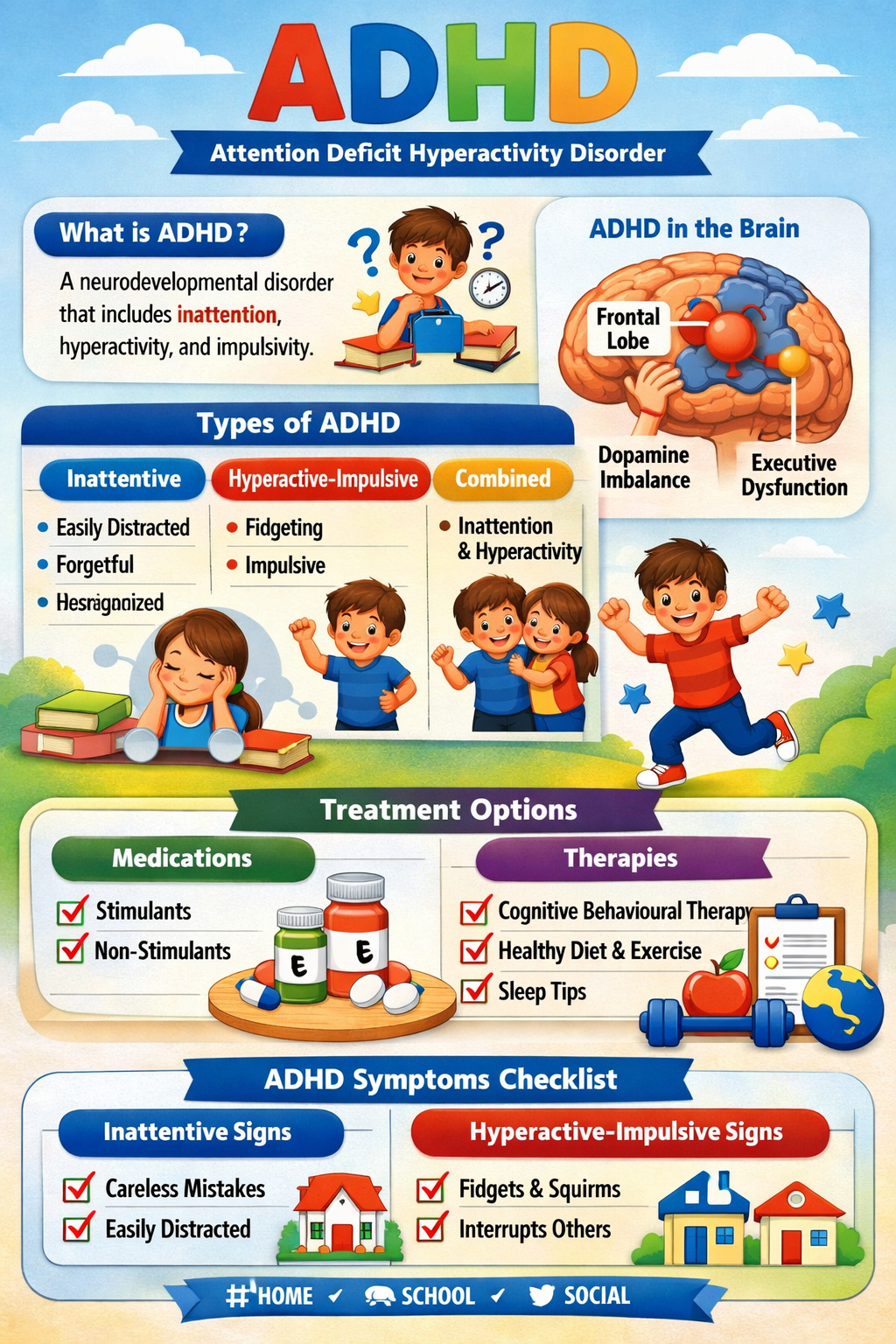
ADHD is a neurodevelopmental condition that affects attention, impulse control, and activity levels. It has three recognised presentations.It has three recognised presentations:
Inattentive ADHD – forgetfulness, disorganisation, difficulty sustaining focus.
Hyperactive‑impulsive ADHD – restlessness, excessive talking, impulsive decisions.
Combined ADHD – features of both.
The Neurobiology and Causes of ADHD
ADHD is linked to executive dysfunction in the frontostriatal circuits. These brain pathways regulate attention, planning, and inhibition.
Neuroimaging shows reduced prefrontal cortex activity.
Dopamine and noradrenaline imbalances play a central role.
A study by Carrington et al., 2025 stated that disrupted synchronisation across executive and emotional networks contributes to ADHD symptoms.
Inattentive ADHD – forgetfulness, disorganisation, difficulty sustaining focus.
Hyperactive‑impulsive ADHD – restlessness, excessive talking, impulsive decisions.
Combined ADHD – features of both.
Symptoms and Clinical Presentation Across the Lifespan
ADHD Symptoms in Children and Adolescents
Children may show:
Fidgeting and restlessness
Difficulty following instructions
Careless mistakes in schoolwork
Impulsive behaviour
How Adult ADHD Manifests Differently
Adults often present with:
Poor time management
Forgetfulness and disorganisation
Emotional dysregulation
Difficulty sustaining attention at work
Symptoms evolve, meaning hyperactive traits in childhood may shift to inattentive features in adulthood.
How is ADHD Diagnosed? (DSM‑5 and NICE Guidelines)
Diagnosis requires:
DSM‑5 criteria: ≥6 symptoms in children, ≥5 in adults, lasting ≥6 months, across ≥2 settings.
NICE NG87: structured interview, collateral history, and exclusion of other causes.
Evidence‑Based Treatment and Clinical Management
Pharmacological Interventions (Stimulants vs. Non‑Stimulants)
Stimulants (methylphenidate, amphetamines) are first‑line, effective in most cases.
Non‑stimulants (atomoxetine, guanfacine, bupropion) are alternatives when stimulants are unsuitable.
Non‑Pharmacological Strategies (CBT and Lifestyle Adjustments)
CBT improves organisation, coping skills, and emotional regulation.
Lifestyle adjustments: sleep hygiene, structured routines, reduced caffeine, and mindfulness.
Frequently Asked Questions (FAQ)
Is ADHD only a childhood disorder?
No, it often persists into adulthood.
Can ADHD be treated without medication?
Yes, CBT and lifestyle changes can help.
Does diet affect ADHD?
Evidence is mixed, but balanced nutrition supports overall wellbeing
Is ADHD overdiagnosed?
Global prevalence is ~5%, and diagnostic criteria ensure accuracy.
Refrences
Wu, Y‑H. et al. (2012) White matter tract integrity of frontostriatal circuit in ADHD. Human Brain Mapping, 35(1), pp.199–212. doi: 10.1002/hbm.22169.
Carrington, R. (2025) The Neurodevelopmental Architecture of ADHD. Journal of Innovations in Medical Research, 4(6). doi: 10.63593/JIMR.2788-7022.2025.12.003.
NICE (2018, updated 2019) Attention deficit hyperactivity disorder: diagnosis and management (NG87). Available at: https://www.nice.org.uk/guidance/ng87.
CDC (2026) Symptoms and Treatment of ADHD. Available at: https://www.cdc.gov/adhd.
NIMH (2026) Attention‑Deficit/Hyperactivity Disorder: What You Need to Know. Available at: https://www.nimh.nih.gov.